Articles

Fine Art Shipping Insurance: What Most Shippers Aren't Telling You
Paying for 'insurance' when shipping artwork through FedEx, UPS, or an art handler? You may not be as covered as you think. Learn the difference between declared value coverage and true fine art insurance, and what artists, galleries, and collectors need to know before the next shipment.
Read More -->
How the SCOTUS Montgomery Ruling Impacts Art Shipping Liability
The Montgomery v. Caribe Transport SCOTUS ruling changes how art shipping liability works for galleries, collectors, dealers, museums, and artists. Learn what changed, who's at risk, and how to vet carriers before your next shipment.
Read More -->
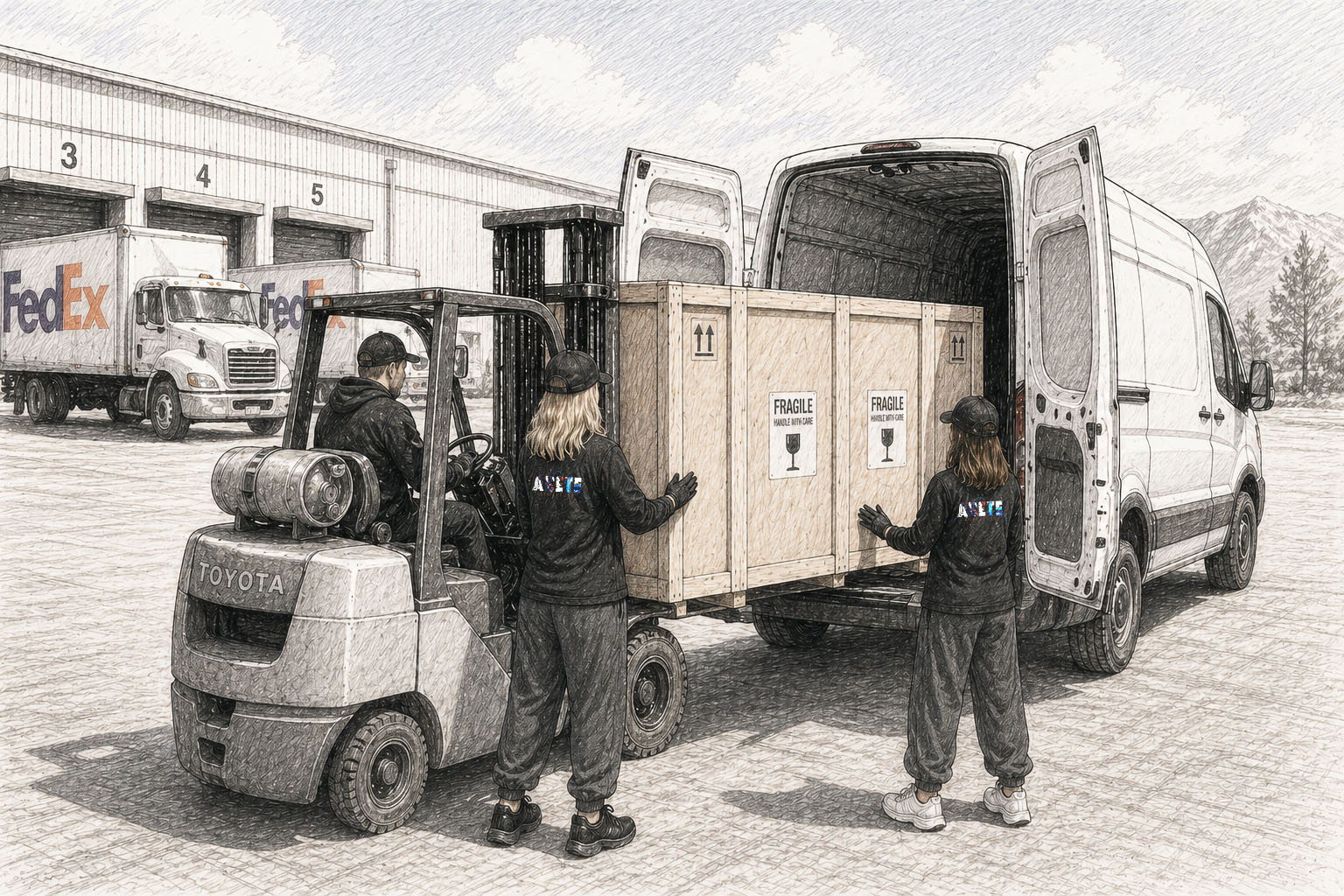
Last-Mile Delivery in Colorado's Mountain Towns: A Guide for Fine Art and High-Value Shipments
What last-mile delivery means for fine art and high-value shipments in Telluride, Aspen, and Crested Butte, and in rural and remote mountain destinations throughout Colorado.
Read More -->
Why Is Fine Art Shipping So Expensive? (And Why It’s Not What You Think)
Fine art shipping costs more than standard freight due to specialized handling, insurance structure, compliance, and risk management. Learn why artwork requires a different level of transport care.
Read More -->

"Aiding and Abetting" in Fine Art Shipping? Stop Hiring Illegal Carriers to Ship Artwork
Shippers can face serious legal, financial, and operational consequences for hiring a carrier that lacks proper federal licensing or operating authority when transporting artwork and high-value goods across state lines.
Read More -->

Why Vetting Your Fine Art Shipper Matters
Hiring an unlicensed fine art shipping company in Colorado can put your artwork, reputation, and wallet at serious risk. Here’s what galleries, artists, and collectors need to know.
Read More -->

Understanding Fine Art Shipping Insurance: What You Need to Know
Not sure if your artwork is actually insured during transit? Learn what all-risk fine art insurance covers, what declared value protection plans don't, and what to ask your art shipper before you ship.
Read More -->
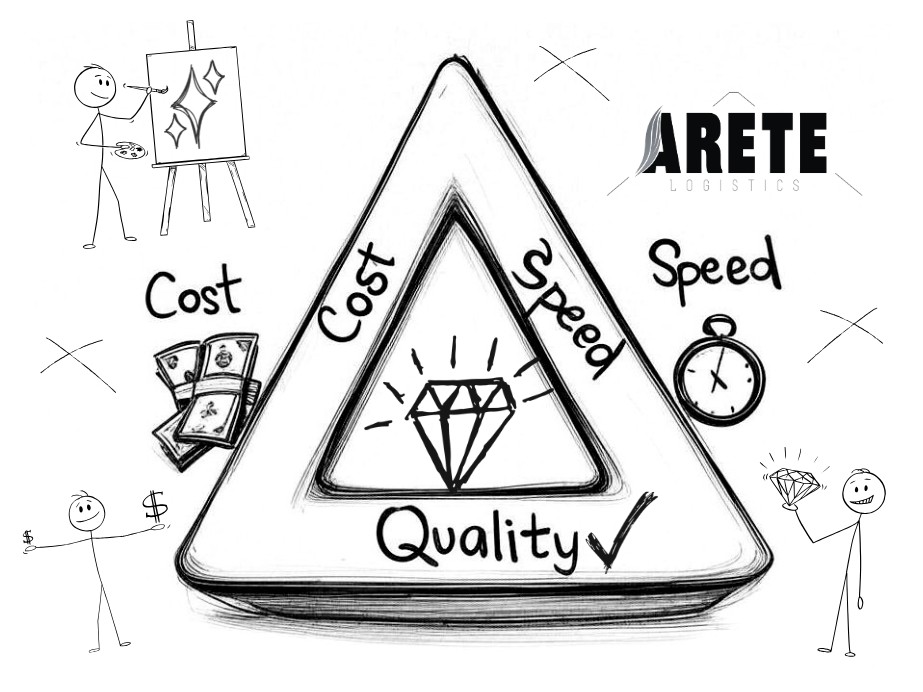
The “Iron Triangle” in Fine Art Shipping: Cost, Speed, & Quality
In fine art shipping, you can't optimize for cost, speed, and quality at the same time. Here's what the Iron Triangle means and how to make smarter trade-offs.
Read More -->
Why Is Fine Art Shipping So Expensive? (And Why It’s Not What You Think)
Most people compare art shipping to standard parcels or general freight. That’s where the misunderstanding starts.
👉 Fine Art Shipping Isn’t Just “Shipping” And It Was Never Meant to Be
On the surface, moving artwork can look simple.
It’s an object going from one place to another. Plenty of companies claim they can handle that.
That assumption is where things start to break down.
Fine art transport exists as its own discipline for a reason.
Artwork is not just fragile. It is often irreplaceable, historically significant, or financially exposed in ways most cargo is not. A painting is not just a package. A sculpture is not just freight. And unlike most goods in transit, the cost of something going wrong is rarely proportional to the cost of moving it.
That imbalance changes everything.
It is also why fine art shipping costs more.
This is not just transportation. It is controlled risk management from start to finish.
Why Artwork Doesn’t Move Like Normal Freight
Most goods moving through logistics systems are designed around efficiency.
Freight can be stacked, palletized, transferred between terminals, and handled multiple times without significant consequence. The system assumes durability. It assumes repeatability. It assumes that if something shifts, it can be corrected or replaced.
Artwork does not operate under those assumptions.
A painting can be affected by pressure in ways that are not immediately visible. A sculpture can be structurally compromised by movement that would be considered normal in freight transport. Even vibration, humidity, and loading orientation can introduce risk over time.
Unlike most goods, artwork often does not have a true replacement.
Because of this, fine art transport is built differently.
Not around efficiency, but around control.
That shift from efficiency to control is one of the primary reasons the cost increases.
Why Fine Art Shipping Costs More Than Standard Shipping
Fine art shipping costs more than standard freight or general shipping because it requires a completely different level of handling, risk management, and care.
Typical logistics systems are designed for speed and volume. Fine art transport is built around protecting individual pieces. Artwork often requires specialized packing or crating, limited handling touchpoints, trained handlers, and careful routing to prevent damage from vibration, pressure, temperature changes, or improper loading.
Pricing reflects these additional requirements, along with the level of responsibility involved in transporting irreplaceable or high-value items.
Where Fine Art Shipping Fits in the Broader Logistics Industry
To understand pricing, it helps to zoom out.
Fine art transport is not an upgraded version of standard shipping. It operates in a different part of the logistics ecosystem.
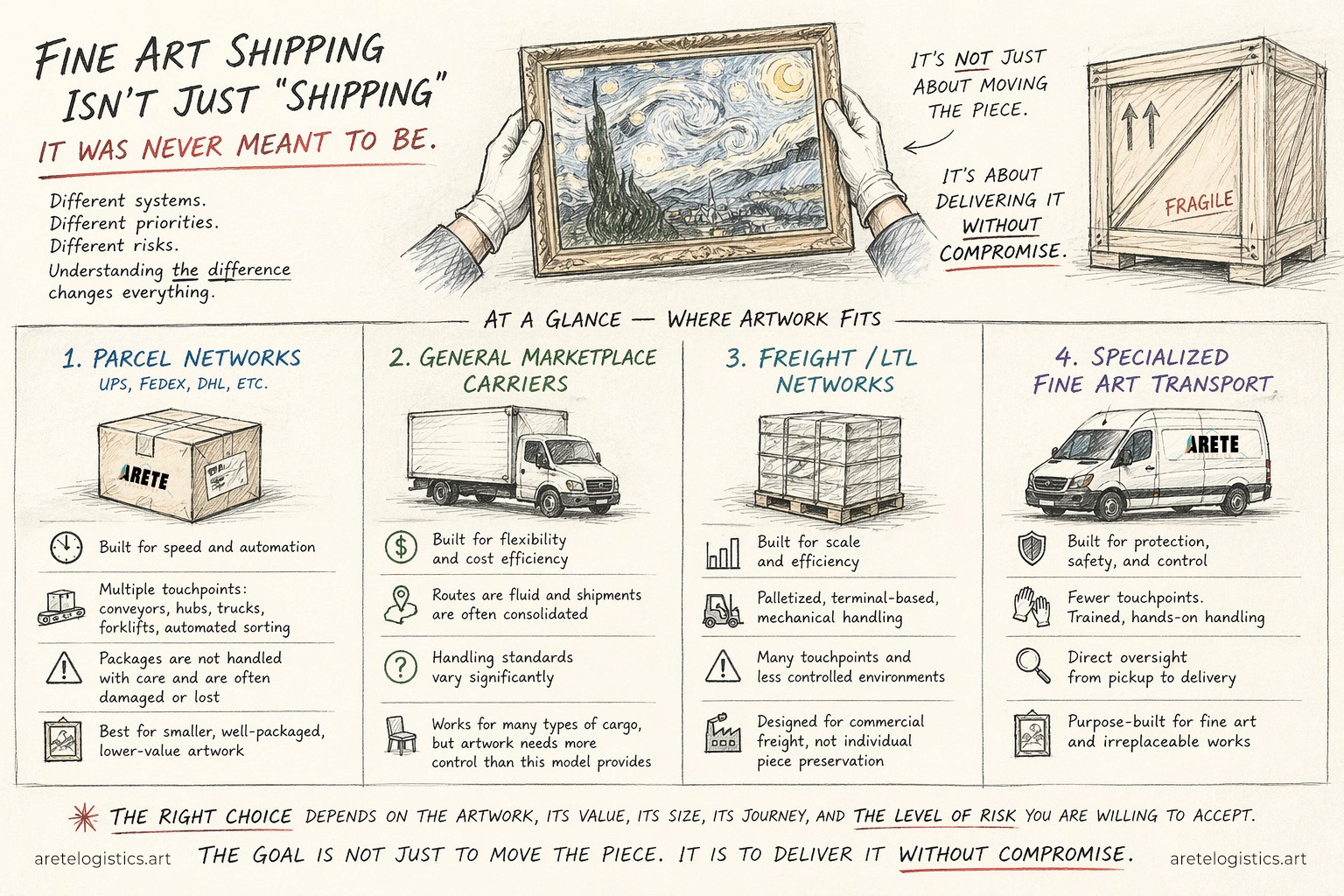
Most transport services fall into four categories:
Specialized Fine Art Transport
Fine art transport exists because artwork does not move safely within either of those systems. Instead of prioritizing speed or volume, specialized carriers prioritize handling, protection, safety, and control.
Fewer touchpoints.
Direct oversight.
Specialized handling.
Intentional routing.
Every decision is made to reduce risk.
Within this category, there is still an extremely wide range of how that work is executed.
Parcel Networks (UPS, FedEx, DHL, and Similar Companies)
Parcel shipping is commonly used for smaller or lower-value artwork where size, weight, and packaging allow it to move through standard carrier systems.
These networks are built for speed, scale, and automated handling through hubs and sorting facilities. Items move through multiple touchpoints, including conveyor systems, forklifts, trucks, and automated sorting equipment, where packages are processed quickly rather than individually handled.
Parcel shipping can be a practical and cost-efficient option for artwork.
However, because of the sheer volume and level of automation involved, the risk of damage, misrouting, or loss can be high.
General Marketplace Carriers
General and marketplace carriers handle a wide range of shipments, from furniture and household goods to equipment, vehicles, and general freight.
Many operate through online, bid-based systems where shipments are posted and accepted based on availability, route, and price.
These models are built around flexibility and cost efficiency. Shipments are often consolidated, routes are fluid, and handling standards can vary significantly depending on the carrier.
That approach works well for many types of cargo.
Artwork typically requires a different level of handling and control.
Freight & LTL Networks
Freight systems are engineered for scale.
Goods are palletized, routed through terminals, transferred between vehicles, and consolidated to maximize efficiency. It is a highly optimized system, but one that introduces multiple touchpoints, mechanical handling, and environments that are not controlled for sensitive objects.
The goal is cost efficiency across large volumes, not preservation of individual pieces.
At a Glance — Where Artwork Fits into Transport logistics
Category | Specialized Fine | Parcel Networks | General Marketplace Carriers | Freight & LTL Networks |
|---|---|---|---|---|
Primary Goal | Control & preservation | Speed & automation | Speed & cost efficiency | Efficiency & scale |
Handling Style | Hands-on, specialized handling | Automated / standardized | Varies greatly by carrier | Palletized / mechanized |
Touchpoints | Minimal | Multiple (sorting hubs, conveyors, trucks) | Multiple / inconsistent | Many (terminals) |
Risk Tolerance | Very low | Moderate to high | Moderate to high | High |
Best For | Fine art & irreplaceables | Small, well-packaged artwork, general goods | General goods & flexible shipments | Commercial freight |
The Spectrum of Fine Art Transport Companies
Even within specialized art transport, not all providers operate at the same level.
Institutional "Blue-Chip" Carriers
These companies support major galleries, museums, auction houses, and international art fairs.
They operate at scale across national and global networks, with highly developed infrastructure that can include climate-controlled storage, standardized handling protocols, dedicated art handlers, and full international logistics coordination, including customs management and exhibition logistics.
Their strength is systemization.
That system comes at a cost.
Every part of the process is structured, documented, and repeatable, which is essential when managing high volumes of valuable and historically significant works across multiple locations.
That level of structure is what defines both their reliability and their pricing. Large teams, specialized facilities, and global coordination systems all contribute to a higher cost structure, which is reflected in pricing.
Independent and Regional Fine Art Carriers
Independent carriers operate differently.
Smaller teams. Direct communication. More flexibility in how shipments are built and executed. They often combine shared routes, dedicated shipments, rural and remote deliveries, last-mile delivery and hotshot transport depending on the situation.
Rather than relying on fixed systems or rigid scheduling, they adapt transport planning to the needs of each individual piece and route.
Their strength is in their positioning.
Independent carriers sit between highly structured institutional providers and informal operators, offering a balance of flexibility, control, and accountability.
In many cases, this also allows for more practical handling approaches such as professional soft-wrap packing when appropriate, which can reduce the requirement for boxing or crating while still maintaining careful, controlled transport standards.
This is where Arête Logistics operates.
The value in this category comes from balance. Pricing reflects hands-on care, direct oversight, proper licensing and insurance, and specialized art handling practices, while avoiding the overhead of large institutional systems and maintaining far higher standards of structure and accountability than unregulated operators. For a full breakdown of what compliant insurance looks like, see our guide to fine art shipping insurance →
Unregulated or Informal Operators "Ghost Carriers"
At the far end of the spectrum are operators who may present themselves as art shippers but do not operate within the same regulatory or professional framework as licensed carriers. They drive the classic art shipping "shadow market" operation.
In some cases, these providers may not hold active federal interstate operating authority, carry appropriate commercial insurance, or maintain coverage that is actually valid for high-value goods or specialized cargo.
Rates are often lower, if not the lowest, but so is structure and accountability.
In many cases, that difference is not visible until something goes wrong. It only becomes clear when there is a loss, damage, or compliance issue, and documentation is reviewed after the fact.
It’s a house of cards for both the carrier and the shippers.
By knowingly hiring an illegal carrier to save money, shippers are opening themselves up to massive legal liabilities that far outweigh any savings on freight rates.
👉 Learn more about the downsides of hiring "ghost carriers"
At a Glance — Fine Art Transport Options
Category | Institutional "Blue-Chip" Carriers | Independent Carriers | Unregulated Operators |
|---|---|---|---|
Clients | Museums, galleries | Galleries, collectors | Cost-driven clients |
Reach | National & international | Regional to national | Inconsistent |
Service Model | Structured | Concierge-style | Informal |
Routing | Scheduled / consolidated | Shared, dedicated, hotshot | Undefined |
Handling | Systemized teams | Direct oversight | Low |
Compliance | Fully licensed | Fully licensed | Often non-compliant |
Insurance | Institutional-grade | Properly structured | Often unclear |
Pricing | Highest | Mid-range | Lowest |
Why This Distinction Matters Early
By this point, most people are not just comparing quotes. They are trying to understand why those quotes are so different.
The answer is not arbitrary. It is structural.
Different systems, different levels of control, and different levels of accountability all influence cost. Understanding that early changes how decisions get made.
Where This Leaves You
Fine art shipping is not expensive because of distance alone. It costs more because standard logistics systems are not designed for what artwork requires.
At Arête Logistics, that means building routes intentionally, balancing shared and dedicated transport when appropriate, and maintaining direct oversight from pickup through delivery, while staying fully aligned with legal requirements, proper insurance coverage, and industry standards.
It’s also important to understand that the three categories of fine art transport are not competing on the same terms. Blue-chip institutional carriers, independent regional carriers, and unregulated operators operate under entirely different structures, responsibilities, and cost realities.
Expecting them to compete purely on price alone creates a false comparison that overlooks the standards, compliance, and accountability required in legitimate fine art transport.
Independent and institutional carriers are not designed to participate in a “race to the bottom” with operators who are not being held to the same regulatory or insurance standards.
Before you compare quotes, it's worth understanding why vetting your shipper matters as much as the price →
Closing Thought
Shipping artwork is not expensive because it is complicated.
It costs more because it requires a level of care, control, and accountability that most logistics systems are not built to provide. The goal is not just to move the piece. It is to deliver it without compromise, and without shortcuts.
Once you understand that, the pricing stops feeling inflated.
It starts to make sense.
Why Is Fine Art Shipping So Expensive? (And Why It’s Not What You Think)
Most people compare art shipping to standard parcels or general freight. That’s where the misunderstanding starts.
👉 Fine Art Shipping Isn’t Just “Shipping” And It Was Never Meant to Be
On the surface, moving artwork can look simple.
It’s an object going from one place to another. Plenty of companies claim they can handle that.
That assumption is where things start to break down.
Fine art transport exists as its own discipline for a reason.
Artwork is not just fragile. It is often irreplaceable, historically significant, or financially exposed in ways most cargo is not. A painting is not just a package. A sculpture is not just freight. And unlike most goods in transit, the cost of something going wrong is rarely proportional to the cost of moving it.
That imbalance changes everything.
It is also why fine art shipping costs more.
This is not just transportation. It is controlled risk management from start to finish.
Why Artwork Doesn’t Move Like Normal Freight
Most goods moving through logistics systems are designed around efficiency.
Freight can be stacked, palletized, transferred between terminals, and handled multiple times without significant consequence. The system assumes durability. It assumes repeatability. It assumes that if something shifts, it can be corrected or replaced.
Artwork does not operate under those assumptions.
A painting can be affected by pressure in ways that are not immediately visible. A sculpture can be structurally compromised by movement that would be considered normal in freight transport. Even vibration, humidity, and loading orientation can introduce risk over time.
Unlike most goods, artwork often does not have a true replacement.
Because of this, fine art transport is built differently.
Not around efficiency, but around control.
That shift from efficiency to control is one of the primary reasons the cost increases.
Why Fine Art Shipping Costs More Than Standard Shipping
Fine art shipping costs more than standard freight or general shipping because it requires a completely different level of handling, risk management, and care.
Typical logistics systems are designed for speed and volume. Fine art transport is built around protecting individual pieces. Artwork often requires specialized packing or crating, limited handling touchpoints, trained handlers, and careful routing to prevent damage from vibration, pressure, temperature changes, or improper loading.
Pricing reflects these additional requirements, along with the level of responsibility involved in transporting irreplaceable or high-value items.
Where Fine Art Shipping Fits in the Broader Logistics Industry
To understand pricing, it helps to zoom out.
Fine art transport is not an upgraded version of standard shipping. It operates in a different part of the logistics ecosystem.
Most transport services fall into four categories:
Specialized Fine Art Transport
Fine art transport exists because artwork does not move safely within either of those systems. Instead of prioritizing speed or volume, specialized carriers prioritize handling, protection, safety, and control.
Fewer touchpoints.
Direct oversight.
Specialized handling.
Intentional routing.
Every decision is made to reduce risk.
Within this category, there is still an extremely wide range of how that work is executed.
Parcel Networks (UPS, FedEx, DHL, and Similar Companies)
Parcel shipping is commonly used for smaller or lower-value artwork where size, weight, and packaging allow it to move through standard carrier systems.
These networks are built for speed, scale, and automated handling through hubs and sorting facilities. Items move through multiple touchpoints, including conveyor systems, forklifts, trucks, and automated sorting equipment, where packages are processed quickly rather than individually handled.
Parcel shipping can be a practical and cost-efficient option for artwork.
However, because of the sheer volume and level of automation involved, the risk of damage, misrouting, or loss can be high.
General Marketplace Carriers
General and marketplace carriers handle a wide range of shipments, from furniture and household goods to equipment, vehicles, and general freight.
Many operate through online, bid-based systems where shipments are posted and accepted based on availability, route, and price.
These models are built around flexibility and cost efficiency. Shipments are often consolidated, routes are fluid, and handling standards can vary significantly depending on the carrier.
That approach works well for many types of cargo.
Artwork typically requires a different level of handling and control.
Freight & LTL Networks
Freight systems are engineered for scale.
Goods are palletized, routed through terminals, transferred between vehicles, and consolidated to maximize efficiency. It is a highly optimized system, but one that introduces multiple touchpoints, mechanical handling, and environments that are not controlled for sensitive objects.
The goal is cost efficiency across large volumes, not preservation of individual pieces.
At a Glance — Where Artwork Fits into Transport logistics
Category | Specialized Fine | Parcel Networks | General Marketplace Carriers | Freight & LTL Networks |
|---|---|---|---|---|
Primary Goal | Control & preservation | Speed & automation | Speed & cost efficiency | Efficiency & scale |
Handling Style | Hands-on, specialized handling | Automated / standardized | Varies greatly by carrier | Palletized / mechanized |
Touchpoints | Minimal | Multiple (sorting hubs, conveyors, trucks) | Multiple / inconsistent | Many (terminals) |
Risk Tolerance | Very low | Moderate to high | Moderate to high | High |
Best For | Fine art & irreplaceables | Small, well-packaged artwork, general goods | General goods & flexible shipments | Commercial freight |
The Spectrum of Fine Art Transport Companies
Even within specialized art transport, not all providers operate at the same level.
Institutional "Blue-Chip" Carriers
These companies support major galleries, museums, auction houses, and international art fairs.
They operate at scale across national and global networks, with highly developed infrastructure that can include climate-controlled storage, standardized handling protocols, dedicated art handlers, and full international logistics coordination, including customs management and exhibition logistics.
Their strength is systemization.
That system comes at a cost.
Every part of the process is structured, documented, and repeatable, which is essential when managing high volumes of valuable and historically significant works across multiple locations.
That level of structure is what defines both their reliability and their pricing. Large teams, specialized facilities, and global coordination systems all contribute to a higher cost structure, which is reflected in pricing.
Independent and Regional Fine Art Carriers
Independent carriers operate differently.
Smaller teams. Direct communication. More flexibility in how shipments are built and executed. They often combine shared routes, dedicated shipments, rural and remote deliveries, last-mile delivery and hotshot transport depending on the situation.
Rather than relying on fixed systems or rigid scheduling, they adapt transport planning to the needs of each individual piece and route.
Their strength is in their positioning.
Independent carriers sit between highly structured institutional providers and informal operators, offering a balance of flexibility, control, and accountability.
In many cases, this also allows for more practical handling approaches such as professional soft-wrap packing when appropriate, which can reduce the requirement for boxing or crating while still maintaining careful, controlled transport standards.
This is where Arête Logistics operates.
The value in this category comes from balance. Pricing reflects hands-on care, direct oversight, proper licensing and insurance, and specialized art handling practices, while avoiding the overhead of large institutional systems and maintaining far higher standards of structure and accountability than unregulated operators. For a full breakdown of what compliant insurance looks like, see our guide to fine art shipping insurance →
Unregulated or Informal Operators "Ghost Carriers"
At the far end of the spectrum are operators who may present themselves as art shippers but do not operate within the same regulatory or professional framework as licensed carriers. They drive the classic art shipping "shadow market" operation.
In some cases, these providers may not hold active federal interstate operating authority, carry appropriate commercial insurance, or maintain coverage that is actually valid for high-value goods or specialized cargo.
Rates are often lower, if not the lowest, but so is structure and accountability.
In many cases, that difference is not visible until something goes wrong. It only becomes clear when there is a loss, damage, or compliance issue, and documentation is reviewed after the fact.
It’s a house of cards for both the carrier and the shippers.
By knowingly hiring an illegal carrier to save money, shippers are opening themselves up to massive legal liabilities that far outweigh any savings on freight rates.
👉 Learn more about the downsides of hiring "ghost carriers"
At a Glance — Fine Art Transport Options
Category | Institutional "Blue-Chip" Carriers | Independent Carriers | Unregulated Operators |
|---|---|---|---|
Clients | Museums, galleries | Galleries, collectors | Cost-driven clients |
Reach | National & international | Regional to national | Inconsistent |
Service Model | Structured | Concierge-style | Informal |
Routing | Scheduled / consolidated | Shared, dedicated, hotshot | Undefined |
Handling | Systemized teams | Direct oversight | Low |
Compliance | Fully licensed | Fully licensed | Often non-compliant |
Insurance | Institutional-grade | Properly structured | Often unclear |
Pricing | Highest | Mid-range | Lowest |
Why This Distinction Matters Early
By this point, most people are not just comparing quotes. They are trying to understand why those quotes are so different.
The answer is not arbitrary. It is structural.
Different systems, different levels of control, and different levels of accountability all influence cost. Understanding that early changes how decisions get made.
Where This Leaves You
Fine art shipping is not expensive because of distance alone. It costs more because standard logistics systems are not designed for what artwork requires.
At Arête Logistics, that means building routes intentionally, balancing shared and dedicated transport when appropriate, and maintaining direct oversight from pickup through delivery, while staying fully aligned with legal requirements, proper insurance coverage, and industry standards.
It’s also important to understand that the three categories of fine art transport are not competing on the same terms. Blue-chip institutional carriers, independent regional carriers, and unregulated operators operate under entirely different structures, responsibilities, and cost realities.
Expecting them to compete purely on price alone creates a false comparison that overlooks the standards, compliance, and accountability required in legitimate fine art transport.
Independent and institutional carriers are not designed to participate in a “race to the bottom” with operators who are not being held to the same regulatory or insurance standards.
Before you compare quotes, it's worth understanding why vetting your shipper matters as much as the price →
Closing Thought
Shipping artwork is not expensive because it is complicated.
It costs more because it requires a level of care, control, and accountability that most logistics systems are not built to provide. The goal is not just to move the piece. It is to deliver it without compromise, and without shortcuts.
Once you understand that, the pricing stops feeling inflated.
It starts to make sense.