Articles

Fine Art Shipping Insurance: What Most Shippers Aren't Telling You
Paying for 'insurance' when shipping artwork through FedEx, UPS, or an art handler? You may not be as covered as you think. Learn the difference between declared value coverage and true fine art insurance, and what artists, galleries, and collectors need to know before the next shipment.
Read More -->
How the SCOTUS Montgomery Ruling Impacts Art Shipping Liability
The Montgomery v. Caribe Transport SCOTUS ruling changes how art shipping liability works for galleries, collectors, dealers, museums, and artists. Learn what changed, who's at risk, and how to vet carriers before your next shipment.
Read More -->
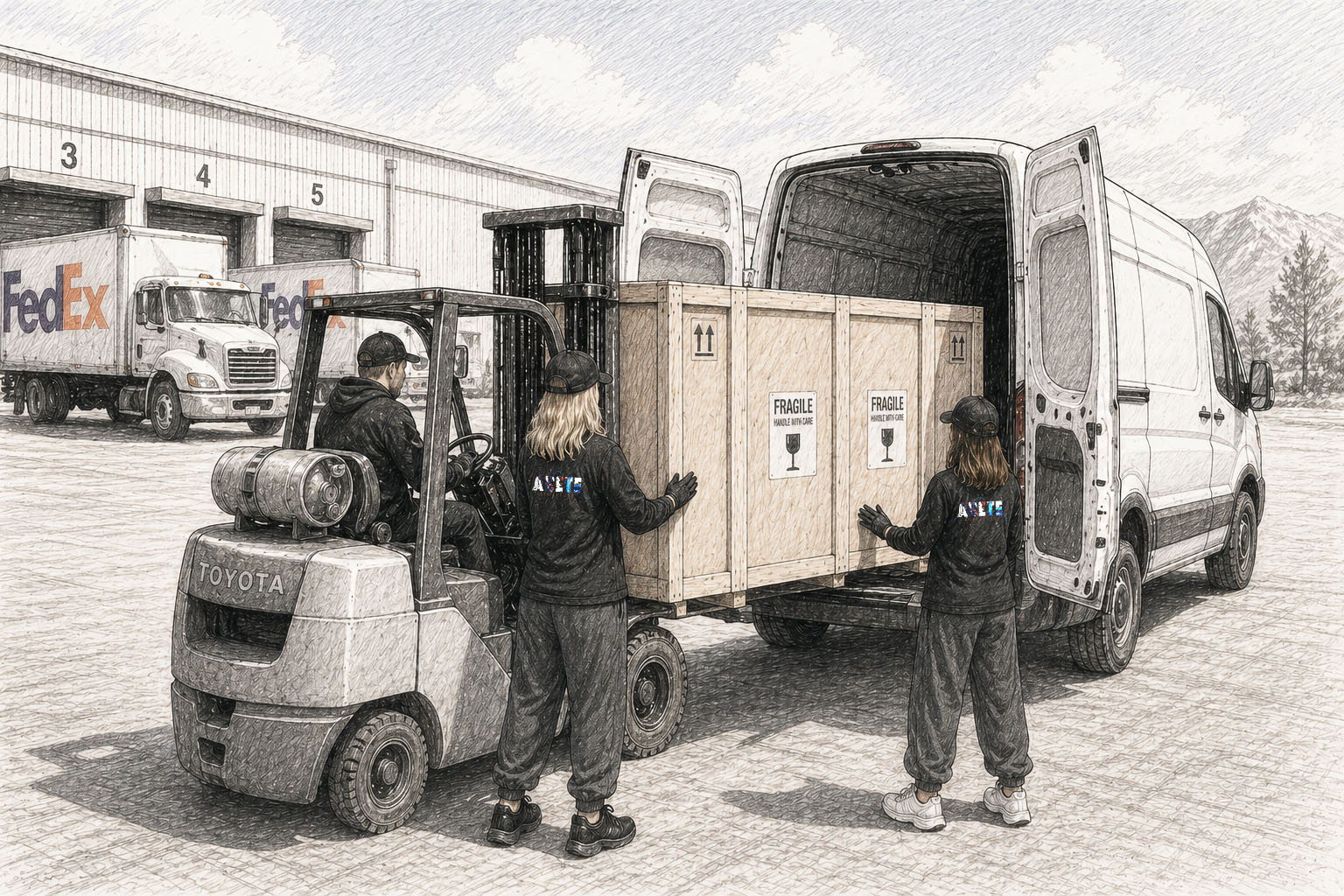
Last-Mile Delivery in Colorado's Mountain Towns: A Guide for Fine Art and High-Value Shipments
What last-mile delivery means for fine art and high-value shipments in Telluride, Aspen, and Crested Butte, and in rural and remote mountain destinations throughout Colorado.
Read More -->
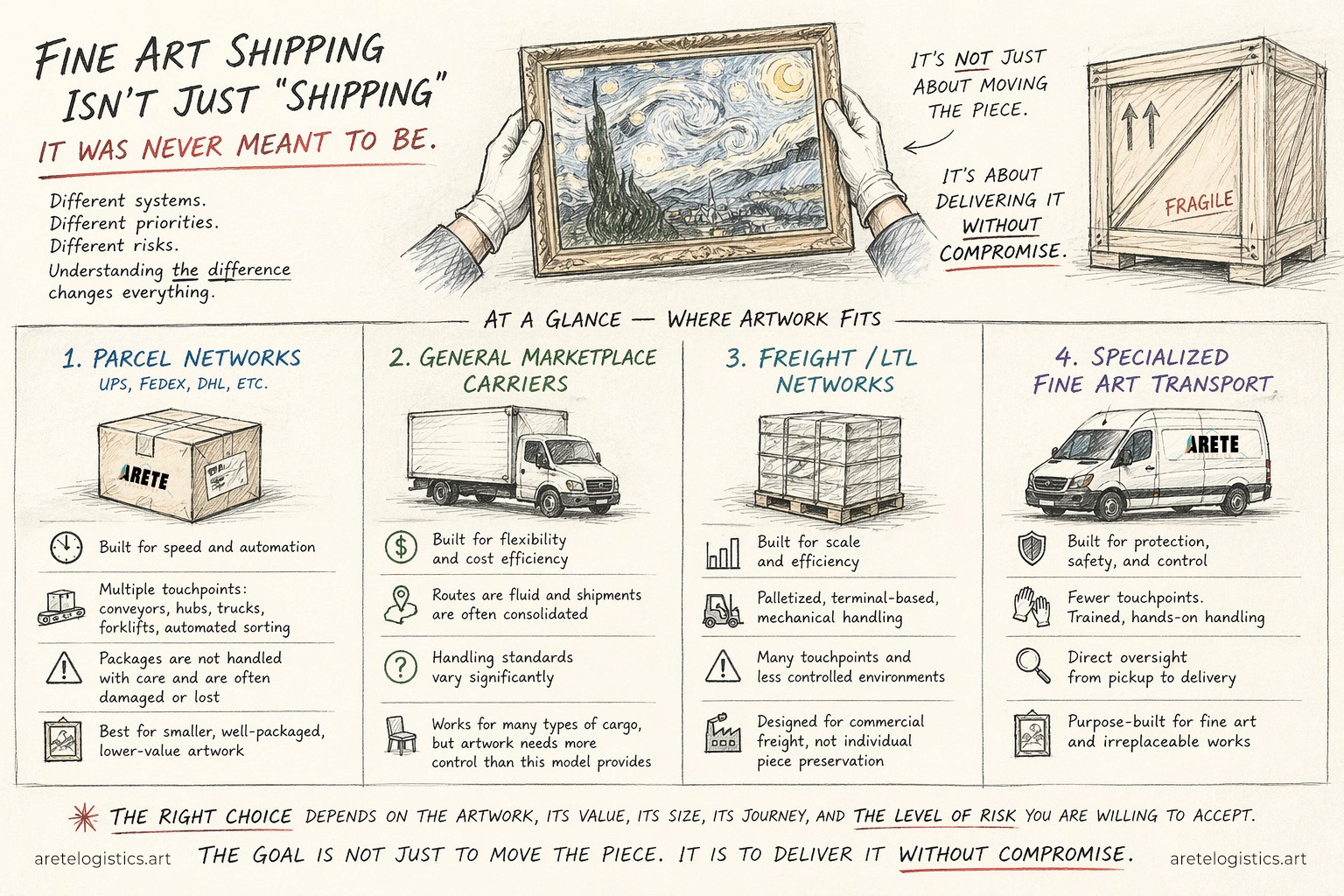
Why Is Fine Art Shipping So Expensive? (And Why It’s Not What You Think)
Fine art shipping costs more than standard freight due to specialized handling, insurance structure, compliance, and risk management. Learn why artwork requires a different level of transport care.
Read More -->
"Aiding and Abetting" in Fine Art Shipping? Stop Hiring Illegal Carriers to Ship Artwork
Shippers can face serious legal, financial, and operational consequences for hiring a carrier that lacks proper federal licensing or operating authority when transporting artwork and high-value goods across state lines.
Read More -->

Why Vetting Your Fine Art Shipper Matters
Hiring an unlicensed fine art shipping company in Colorado can put your artwork, reputation, and wallet at serious risk. Here’s what galleries, artists, and collectors need to know.
Read More -->

Understanding Fine Art Shipping Insurance: What You Need to Know
Not sure if your artwork is actually insured during transit? Learn what all-risk fine art insurance covers, what declared value protection plans don't, and what to ask your art shipper before you ship.
Read More -->

The “Iron Triangle” in Fine Art Shipping: Cost, Speed, & Quality
In fine art shipping, you can't optimize for cost, speed, and quality at the same time. Here's what the Iron Triangle means and how to make smarter trade-offs.
Read More -->
How the SCOTUS Montgomery Ruling Impacts Art Shipping Liability
If you've ever hired someone to ship artwork, whether that's a "blue chip" institutional fine art carrier, an independent art courier, a family-owned art handling service, a regional hauler, a friend-of-a-friend with a SUV, someone with a pickup truck and trailer, or the "man-with-a-van," the Supreme Court's ruling just made your hiring decision a lot more consequential.
On May 14, 2026, the U.S. Supreme Court issued a unanimous 9-0 ruling in Montgomery v. Caribe Transport II, LLC that changed how liability works when a carrier causes harm. It doesn't just affect big freight companies or cross-country truckers. It affects galleries, collectors, dealers, advisors, institutions, and artists. Anyone who selects a carrier and hands over artwork to be transported.
The ruling didn't invent new risk. It removed the legal escape hatch that let negligent carrier selection slide. Here's what changed, why it matters to you specifically, and what you can do about it today.
🏛️ What Did the Montgomery Ruling Actually Change?
For years, a federal law called the Federal Aviation Administration Authorization Act (FAAAA) gave freight brokers and parties who arranged carrier selection a powerful shield against state-level negligence claims. If something went wrong, they could argue: "Federal law governs transportation, so state courts can't hold us liable for choosing a bad carrier."
The Supreme Court unanimously shut that down.
The ruling confirms that federal law does not preempt state-law negligent hiring and selection claims. States retain the authority to hold parties accountable when they fail to exercise ordinary care in selecting who transports goods. That includes brokers. And by extension, it includes anyone who makes a carrier selection decision, including you.
What does that mean in practice? If you hire a carrier that causes harm and you didn't take reasonable steps to verify they were legitimately authorized and insured, that hiring decision is now squarely in the frame.
🎨 Why This Hits Different in the Art World
Most industries have procurement departments, vendor approval processes, and compliance checklists. The art world largely runs on relationships, referrals, and reputation. Someone knows someone who has a van and handles art carefully. A gallery's longtime installer recommends their cousin's transport company. A dealer finds a cheap regional option on a logistics marketplace.
None of those referrals verify FMCSA status. None of them confirm operating authority. None of them check whether the cargo insurance actually covers fine art.
And now, if something goes wrong, whether that's an accident, a damaged piece, or an injured third party, the question won't just be what happened. It will be who selected this carrier, and did they do their homework?
That's the shift. That's why this ruling matters to you.
🚐 Vehicle Size Doesn't Determine Compliance. Period.
Let's put this myth to rest right now, because it's the single biggest source of false confidence in the art shipping market.
There is a widespread belief that federal carrier regulations only apply to large semi-trucks. That a Sprinter van, a cargo SUV, a pickup with an enclosed trailer, or a box truck somehow operates outside those rules. Some carriers even say this out loud. That because they run a single van and "work directly with clients," they don't need the same federal credentials as larger operators.
That is not a legal position. It is a misunderstanding that has put their clients at risk every single time they hired them.
Federal motor carrier regulations apply based on what you're doing, not what you're driving. If a carrier is moving goods commercially across state lines, federal law applies. Full stop. That means they are required to have:
✅ An active USDOT number
✅ Active operating authority (MC authority or USDOT-suffix authority for carriers registered after October 2025)
✅ Commercial auto liability insurance (federal minimum: $750,000)
✅ Commercial cargo insurance
✅ UCR (Unified Carrier Registration)
A Sprinter van without these credentials is not a boutique art shipper. It's an unauthorized carrier, and hiring one is the kind of decision that looks very different in hindsight after a claim.
⚖️ What Is Negligent Hiring? (And Why "I Didn't Know" No Longer Works)
Negligent hiring, also called negligent selection, is a legal doctrine that holds you accountable for harm caused by someone you hired if you failed to exercise reasonable care in choosing them.
The key phrase from Montgomery is "reasonably should know." Courts won't just ask whether you knew a carrier was unauthorized or uninsured. They'll ask whether a reasonable person in your position should have known to check.
Here's what makes that standard almost impossible to escape. Tools like FMCSA SAFER and BrokerSnapshot are free, publicly available, and take about 90 seconds to use.
You can look up any carrier at safer.fmcsa.dot.gov by name, USDOT number, or MC number and immediately see whether their authority is active, whether they've been placed out of service, and whether their insurance is on file.
BrokerSnapshot.com goes even further, letting you search by name, phone number, address, or owner, and also shows whether their business is registered with the state.
If these tools are free, public, and take 90 seconds, and you didn't use them, "I didn't know" is not a defense. It may, in fact, be treated as evidence of negligence. The Montgomery ruling puts that squarely on the table.
🔀 FREIGHT BROKERS, FREIGHT FORWARDERS, AND DOUBLE BROKERING
This is where things get complicated. And it's where a significant number of operators in the art shipping market are in territory that deserves a much closer look.
What Is a Freight Broker?
A freight broker arranges transportation between a shipper and a carrier but doesn't physically move the goods themselves. Think of it as a matchmaker role: they connect you with a carrier, negotiate terms, and manage coordination. Under federal law, this activity requires FMCSA broker authority, a $75,000 surety bond, and active registration, regardless of what the person calls their business or themselves.
What Is a Freight Forwarder?
A freight forwarder goes a step further. They accept responsibility for the entire shipment, take legal custody of the goods, issue documentation, and then arrange the actual transport, often using multiple carriers. This also requires separate FMCSA freight forwarder authority.
What Are Interline Agreements and When Are They Legal?
Two licensed carriers can lawfully partner to move a single shipment — Carrier A handles Denver to Chicago, Carrier B takes Chicago to New York — each under their own active FMCSA authority and insurance. This is called an interline arrangement, and it's a legitimate, disclosed practice. The key word is licensed. An interline arrangement involving an unauthorized carrier doesn't make that operator legal. It potentially makes everyone in the chain liable, including the shipper who never asked who was actually moving the work.
What Is Double Brokering?
Double brokering is when a carrier or broker accepts a shipment and passes it to another operator without the shipper's knowledge or consent. You think Company A is moving your artwork. Company A gave it to Company B, who handed it to Company C. None of those handoffs were disclosed. None were authorized. You have no idea who has your client's piece.
Double brokering is considered fraudulent under federal transportation law and can result in civil penalties, loss of FMCSA authority, and in serious cases, criminal charges. Between 2022 and 2025, fraudulent double brokering schemes drained more than $10 billion from the freight industry. It's not a fringe problem.
What Does This Look Like in the Art World?
The boutique art shipping market has quietly developed an ecosystem of operators who market themselves as premium carriers but function as undisclosed intermediaries. They take your booking, collect your payment, and route your irreplaceable artwork through a network of informal partner carriers you've never vetted and never agreed to use.
Here's a realistic scenario. A gallery books a "regional art logistics specialist" to move a significant sculpture from Santa Fe to a collector in New York. The specialist, operating without MC authority, accepts the job and passes it to a carrier in their informal network. That carrier also lacks MC authority. Their cargo insurance is a consumer-grade policy that excludes commercial freight entirely. The artwork is damaged in transit. Nobody has valid cargo coverage anywhere in the chain.
Here's what surprises most people: even a licensed carrier's standard commercial cargo policy will often exclude fine art, antiques, and valuables outright. And the gallery's own business policy won't fill that gap. Standard commercial policies don't cover losses caused by a carrier's negligence or their coverage failures. Nobody is paid. And if there was a road accident involved and someone was injured, the hiring chain is now under a microscope.
That is double brokering in the art world. It's more common than the industry acknowledges. Post-Montgomery, every gallery, institution, or collector that books through an unvetted intermediary is embedded in that chain whether they know it or not.
The "Middleman" Trap
We see this pattern consistently: operators who genuinely believe that because they don't personally drive the truck, federal compliance requirements don't apply to them. "Coordinator." "Concierge logistics." "I just connect people."
Federal law doesn't care what you call yourself. It cares what you do:
Arrange interstate transport for compensation without holding carrier authority? You may need FMCSA broker authority.
Accept responsibility for a shipment and subcontract the movement? You may be operating as a freight forwarder and need freight forwarder authority.
Hold carrier authority and hand a load to another carrier without the shipper's knowledge? That's double brokering. It's not a gray area.
There's a federal regulation that makes this even more explicit. Under 49 CFR § 390.13, no person shall aid, abet, encourage, or require a motor carrier or its employees to violate federal motor carrier regulations. That means hiring, booking, or facilitating transportation through an unauthorized carrier isn't just a civil liability issue. It can make you a party to the violation itself. You don't have to drive the van to be on the hook. We covered this in detail in our earlier article "Aiding and Abetting" in Fine Art Shipping? Stop Hiring Illegal Carriers to Ship Artwork.
The question to ask anyone who arranges art transportation on your behalf: "Do you hold active FMCSA carrier authority or broker authority, and can I see your USDOT or MC number?" A legitimate operator answers that immediately and without hesitation. If they can't, you need to know that before you hand over the work.
🛡️ THE INSURANCE GAP NOBODY IN THE ART WORLD TALKS ABOUT
Most carriers, even fully licensed and compliant ones, carry commercial cargo policies that explicitly exclude artwork, antiques, and valuables. And if you're counting on your gallery's inland marine or fine art floater policy to cover a transit loss, read the fine print first. Most of those policies contain due diligence clauses — if the carrier you hired lacked valid operating authority, your insurer may deny the claim entirely on the grounds that you failed to exercise reasonable care.
There is no clean insurance solution that makes a bad carrier choice safe. We cover the fine art insurance landscape in detail in Understanding Fine Art Shipping Insurance: What You Need to Know. The short version: vetting your carrier carefully isn't just a legal protection. It may be the only thing that actually protects the artwork.
💥 WHAT HAPPENS WHEN SOMETHING GOES WRONG
Here's the scenario that plays out when none of these boxes get checked.
A gallery hires a regional carrier based on word of mouth. Good reviews, active social media, competitive rate. Seems professional. Nobody checks FMCSA SAFER.
What they missed: the carrier's authority had been placed Out Of Service for refusing a federal safety audit, then later Revoked. They kept taking jobs. Their cargo policy excluded fine art. Their commercial auto liability was void.
En route, there's a serious accident. The artwork is destroyed. A third party is severely injured and files suit. Attorneys trace the chain. The gallery hired the carrier. The gallery didn't check. The carrier's revoked status was publicly searchable in under two minutes.
Under Montgomery, there's no federal preemption shield for that negligent selection claim. Under joint and several liability (49 U.S.C. § 14916), the gallery may be on the hook for the full extent of damages, not just their share.
This is not a hypothetical. Carriers operating in exactly this pattern exist in the Colorado and Mountain West art shipping market right now. We've documented them. We've filed FMCSA reports. The informal networks they've built are larger than most galleries realize.
📋 Who Is Most Exposed After Montgomery?
Institutions, including museums, universities, and major foundations: You carry the deepest pockets and the highest expected duty of care. Complex loan arrangements, multi-leg transports, and vendor subcontracting chains mean the actual carrier may be several steps removed from who you originally booked. If that downstream carrier is unauthorized, your name is still at the top of the hiring chain.
Galleries and dealers: You hire carriers regularly, often on tight timelines and on referral and price. The "regional art shipper" your peers also use may have no valid authority. Every unvetted booking is a liability event.
Advisors and auction houses: Arranging transportation on behalf of clients may constitute broker or freight forwarder activity under federal law. If you connect clients with carriers without verifying FMCSA credentials, you are in the chain.
Artists: You care most about the work and often have the least support structure to vet carriers. The operator offering to move your piece for a few hundred dollars less than a legitimate carrier may have no valid insurance for your work at all.
Collectors: You often defer to the gallery or advisor to arrange shipping. You are allowed, and after Montgomery you are wise, to ask: Who is moving my work, and have you verified their FMCSA status?
✅ The 4-Step Vetting Process (Under 10 Minutes, Always Free)
This is not a burden. It's a 10-minute process that creates a documented paper trail showing you exercised ordinary care. In a post-Montgomery world, that paper trail is your protection.
Do this before every interstate art shipment:
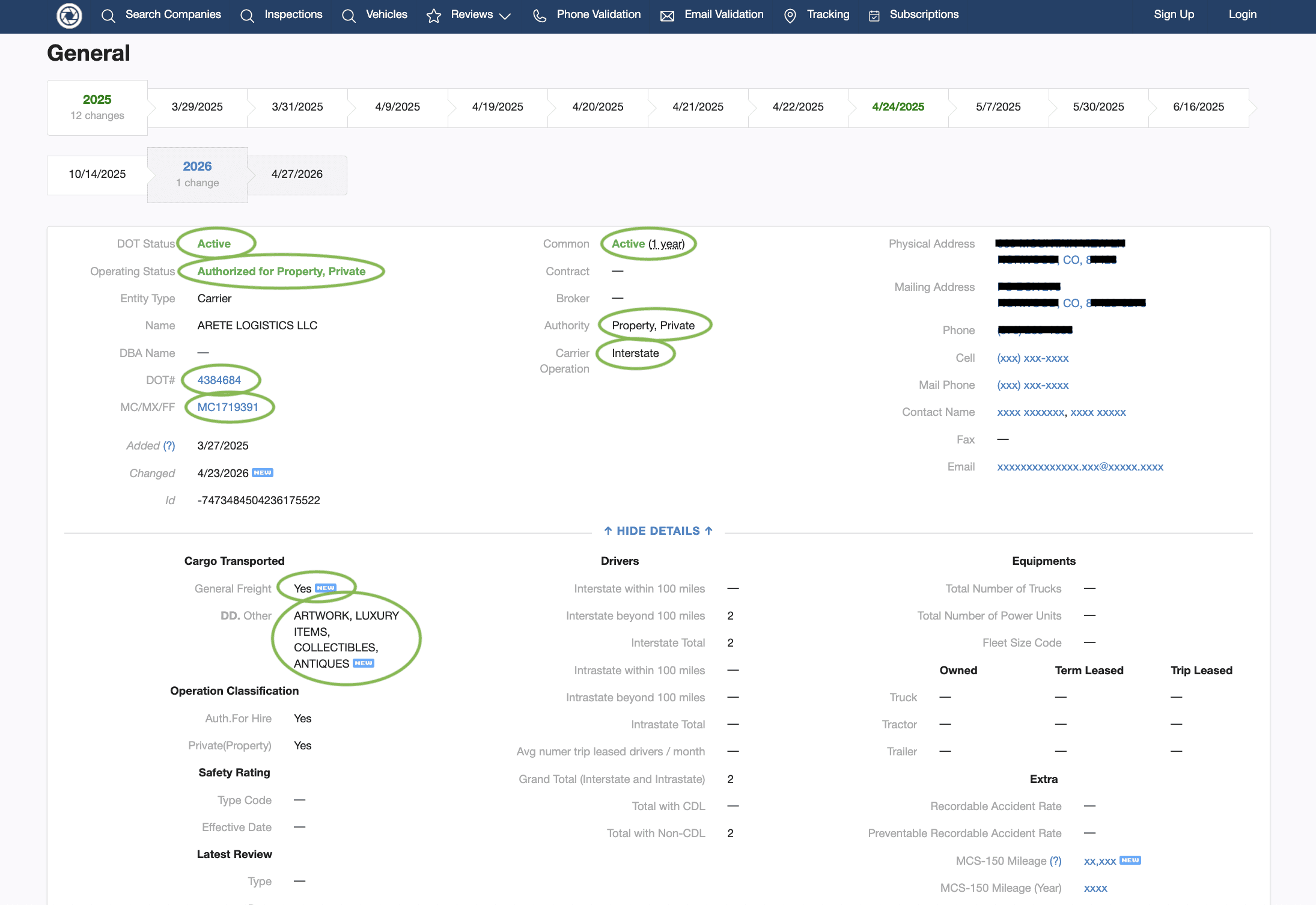
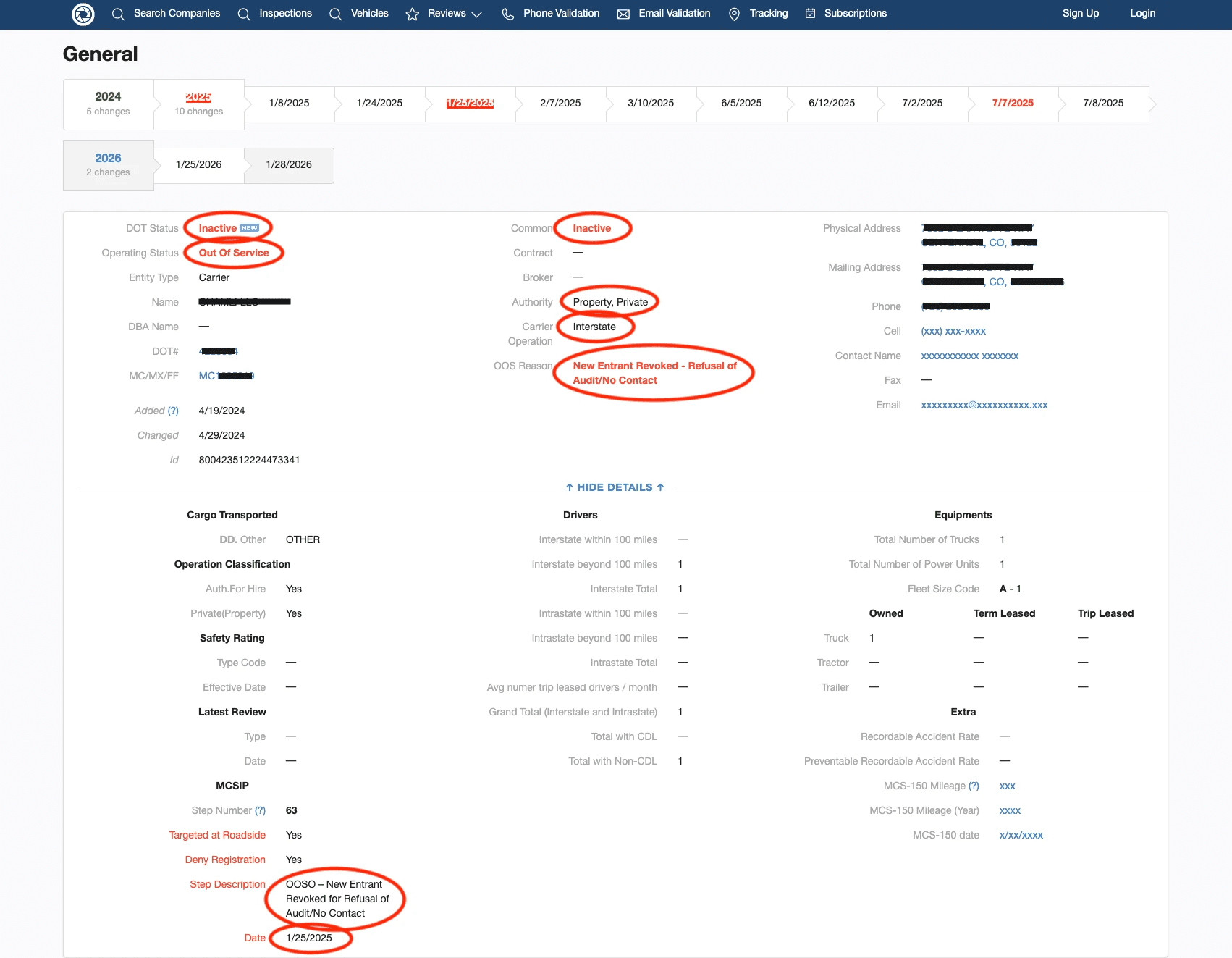
🔎 Step 01 — Run a Quick Check on BrokerSnapshot
Search by carrier name, phone number, business address, owner name, USDOT number, or MC number. BrokerSnapshot aggregates federal operating authority, insurance on file, and state business registration in one view. Fast, accessible, and a great first pass, especially for carriers you haven't worked with before.
Example 1: Authorized | Example 2: Not Authorized |
|---|---|
 |  |
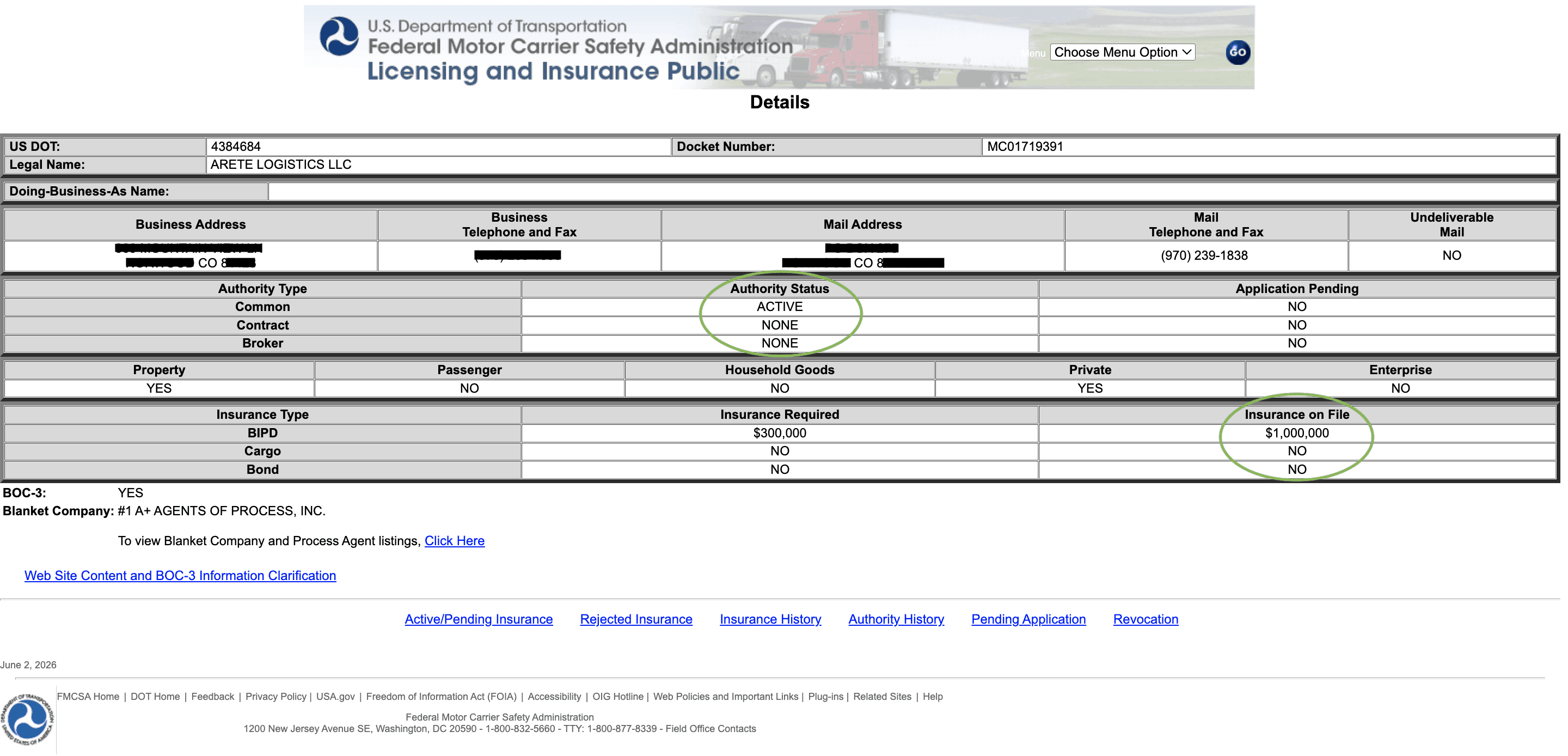
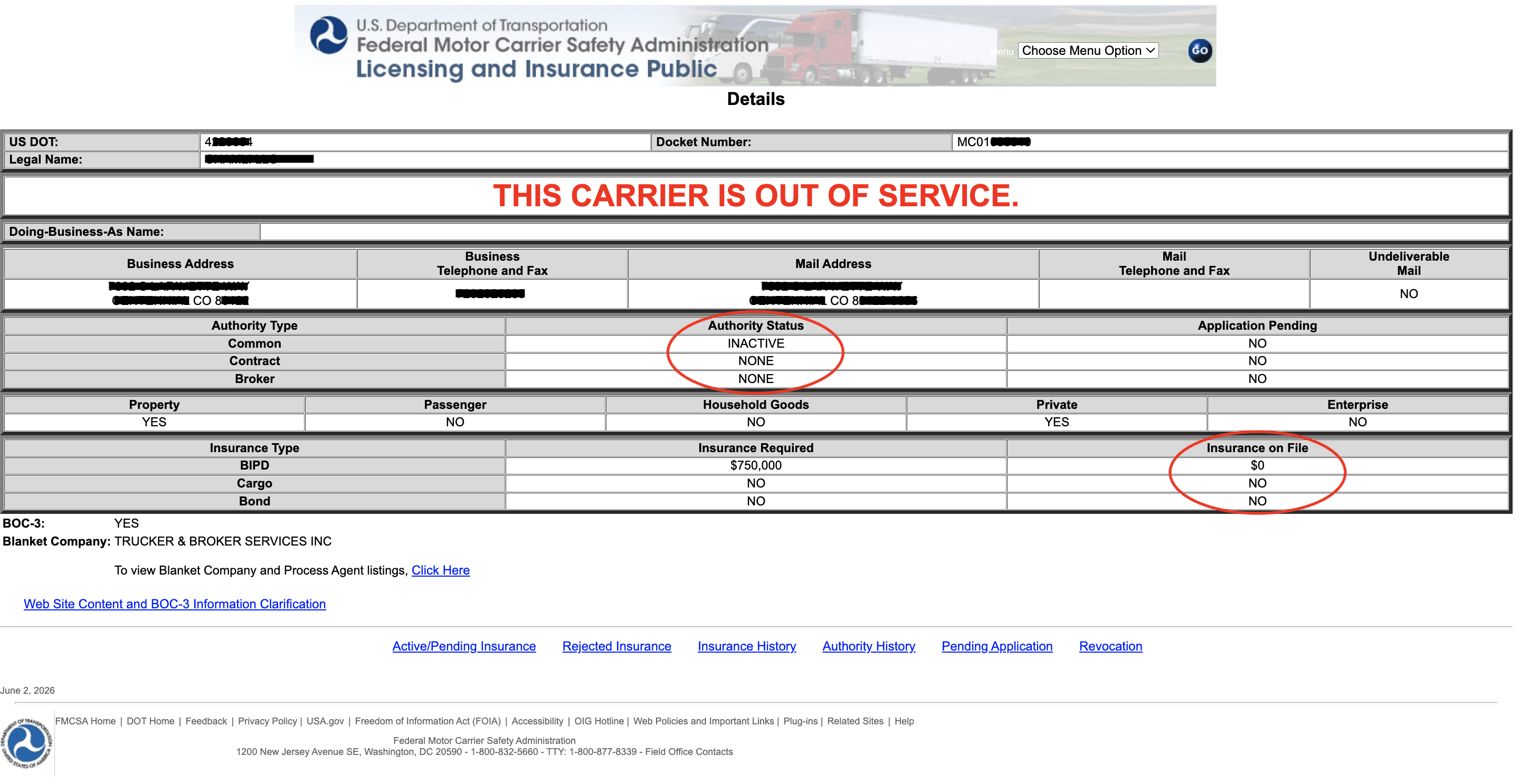
🔎 Step 02 — Verify Directly in FMCSA SAFER
The authoritative federal source. Search by name, USDOT number, or MC number. Check:
Company Snapshot (active/inactive)
Licensing & Insurance tab
UCR registration
Out of Service history
Example 1: Authorized | Example 2: Not Authorized |
|---|---|
 |  |
 |  |
 | |
BrokerSnapshot is convenient. SAFER is definitive. Use both.
🔎 Step 03 — Ask for Their USDOT/MC Number Upfront
A legitimate carrier provides this without hesitation. It should appear on their website, their quote, and their vehicle. Vague answers or claims that vehicle size exempts them from federal requirements are red flags, not reassurances.
Note: As of October 1, 2025, FMCSA stopped issuing new MC numbers and moved to a USDOT-suffix authority system. Existing MC numbers remain valid in legacy records, which is not a red flag. What matters is that Operating Authority status reads "AUTHORIZED FOR PROPERTY."
🔎 Step 04 — Request a Certificate of Insurance and Ask Who's Actually Driving
Get a COI showing commercial auto liability and cargo coverage. Then read it carefully, or have someone read it for you. Most standard commercial cargo policies exclude fine art, antiques, and valuables, and carrier-side fine art cargo coverage is genuinely difficult to obtain in the current insurance market even for fully compliant carriers. A COI is not the policy itself and does not override exclusions buried in the underlying language.
This is also a good moment to review your own transit coverage. If you carry an inland marine or fine art floater policy with a transit rider, check whether it contains a due diligence clause. Hiring an unlicensed carrier may void that coverage when you need it most.
Then ask directly: Will you be transporting this shipment yourself, or will it be handed to another carrier? If subcontracting is involved, get it in writing and verify the subcontractor's FMCSA credentials as well.
🟢 Green Flags: Proceed Only When ALL of These Are Present
✅ USDOT number listed and ACTIVE
✅ Operating authority listed and AUTHORIZED FOR PROPERTY
✅ Out of Service Date: NONE
✅ UCR registration: Current
✅ State registration: Active
✅ Legal name matches vehicle, invoice, and website
✅ COI reflects commercial (not personal) auto liability AND cargo coverage
✅ Cargo coverage does not exclude fine art or valuables (verify the policy language, not just the COI)
✅ If using subcontractors: each one verifiable by USDOT number, disclosed upfront
🔴 Red Flags: Stop If ANY of These Are Present
🚩 Carrier does not appear in FMCSA SAFER (not registered)
🚩 USDOT status: INACTIVE
🚩 Operating Authority: NOT AUTHORIZED / OUT OF SERVICE / REVOKED
🚩 Claims vehicle size exempts them from federal operating authority requirements
🚩 Evasive or defensive when asked for USDOT/MC number
🚩 Insurance is personal auto or consumer-grade cargo product
🚩 COI cargo coverage excludes "artwork," "valuables," or "antiques"
🚩 Carrier cannot explain what their cargo policy actually covers
🚩 Uses partner carriers or subcontractors they cannot identify or won't disclose
🚩 Calls themselves a "middleman" or "coordinator" without FMCSA broker authority
🎯 The Bottom Line
The Montgomery ruling didn't make the art shipping world more dangerous. It made the danger harder to ignore.
If something goes wrong with a shipment, whether that's an accident, a damaged piece, or an injured third party, the question isn't just what happened. It's who hired that carrier, and did they exercise ordinary care? That question now has real legal teeth.
The fix is simple and costs nothing: verify before you book. Check FMCSA SAFER. Check BrokerSnapshot. Ask who's actually moving the work. Get a real COI and read the policy language, not just the certificate. Document what you checked. That 10-minute process is the difference between a defensible decision and an exposed one.
You don't have to be a transportation attorney to ship artwork responsibly. You just have to do the homework. And now you know exactly how.
📎 Resources
FMCSA SAFER Database: safer.fmcsa.dot.gov
BrokerSnapshot: brokersnapshot.com
Why Vetting Your Fine Art Shipper Matters: aretelogistics.art/articles/why-vetting-fine-art-shippers-matters
Aiding and Abetting in Fine Art Shipping: aretelogistics.art/articles/aiding-and-abetting-in-fine-art-shipping
Get an Estimate or Ask Us Anything: aretelogistics.art
Arête Logistics, LLC is a women-owned fine art and luxury goods courier service based in Telluride, Colorado. Fully FMCSA compliant. BBB accredited. Licensed and insured. This article is educational and does not constitute legal advice. For questions specific to your situation, consult a qualified transportation attorney.
How the SCOTUS Montgomery Ruling Impacts Art Shipping Liability
If you've ever hired someone to ship artwork, whether that's a "blue chip" institutional fine art carrier, an independent art courier, a family-owned art handling service, a regional hauler, a friend-of-a-friend with a SUV, someone with a pickup truck and trailer, or the "man-with-a-van," the Supreme Court's ruling just made your hiring decision a lot more consequential.
On May 14, 2026, the U.S. Supreme Court issued a unanimous 9-0 ruling in Montgomery v. Caribe Transport II, LLC that changed how liability works when a carrier causes harm. It doesn't just affect big freight companies or cross-country truckers. It affects galleries, collectors, dealers, advisors, institutions, and artists. Anyone who selects a carrier and hands over artwork to be transported.
The ruling didn't invent new risk. It removed the legal escape hatch that let negligent carrier selection slide. Here's what changed, why it matters to you specifically, and what you can do about it today.
🏛️ What Did the Montgomery Ruling Actually Change?
For years, a federal law called the Federal Aviation Administration Authorization Act (FAAAA) gave freight brokers and parties who arranged carrier selection a powerful shield against state-level negligence claims. If something went wrong, they could argue: "Federal law governs transportation, so state courts can't hold us liable for choosing a bad carrier."
The Supreme Court unanimously shut that down.
The ruling confirms that federal law does not preempt state-law negligent hiring and selection claims. States retain the authority to hold parties accountable when they fail to exercise ordinary care in selecting who transports goods. That includes brokers. And by extension, it includes anyone who makes a carrier selection decision, including you.
What does that mean in practice? If you hire a carrier that causes harm and you didn't take reasonable steps to verify they were legitimately authorized and insured, that hiring decision is now squarely in the frame.
🎨 Why This Hits Different in the Art World
Most industries have procurement departments, vendor approval processes, and compliance checklists. The art world largely runs on relationships, referrals, and reputation. Someone knows someone who has a van and handles art carefully. A gallery's longtime installer recommends their cousin's transport company. A dealer finds a cheap regional option on a logistics marketplace.
None of those referrals verify FMCSA status. None of them confirm operating authority. None of them check whether the cargo insurance actually covers fine art.
And now, if something goes wrong, whether that's an accident, a damaged piece, or an injured third party, the question won't just be what happened. It will be who selected this carrier, and did they do their homework?
That's the shift. That's why this ruling matters to you.
🚐 Vehicle Size Doesn't Determine Compliance. Period.
Let's put this myth to rest right now, because it's the single biggest source of false confidence in the art shipping market.
There is a widespread belief that federal carrier regulations only apply to large semi-trucks. That a Sprinter van, a cargo SUV, a pickup with an enclosed trailer, or a box truck somehow operates outside those rules. Some carriers even say this out loud. That because they run a single van and "work directly with clients," they don't need the same federal credentials as larger operators.
That is not a legal position. It is a misunderstanding that has put their clients at risk every single time they hired them.
Federal motor carrier regulations apply based on what you're doing, not what you're driving. If a carrier is moving goods commercially across state lines, federal law applies. Full stop. That means they are required to have:
✅ An active USDOT number
✅ Active operating authority (MC authority or USDOT-suffix authority for carriers registered after October 2025)
✅ Commercial auto liability insurance (federal minimum: $750,000)
✅ Commercial cargo insurance
✅ UCR (Unified Carrier Registration)
A Sprinter van without these credentials is not a boutique art shipper. It's an unauthorized carrier, and hiring one is the kind of decision that looks very different in hindsight after a claim.
⚖️ What Is Negligent Hiring? (And Why "I Didn't Know" No Longer Works)
Negligent hiring, also called negligent selection, is a legal doctrine that holds you accountable for harm caused by someone you hired if you failed to exercise reasonable care in choosing them.
The key phrase from Montgomery is "reasonably should know." Courts won't just ask whether you knew a carrier was unauthorized or uninsured. They'll ask whether a reasonable person in your position should have known to check.
Here's what makes that standard almost impossible to escape. Tools like FMCSA SAFER and BrokerSnapshot are free, publicly available, and take about 90 seconds to use.
You can look up any carrier at safer.fmcsa.dot.gov by name, USDOT number, or MC number and immediately see whether their authority is active, whether they've been placed out of service, and whether their insurance is on file.
BrokerSnapshot.com goes even further, letting you search by name, phone number, address, or owner, and also shows whether their business is registered with the state.
If these tools are free, public, and take 90 seconds, and you didn't use them, "I didn't know" is not a defense. It may, in fact, be treated as evidence of negligence. The Montgomery ruling puts that squarely on the table.
🔀 FREIGHT BROKERS, FREIGHT FORWARDERS, AND DOUBLE BROKERING
This is where things get complicated. And it's where a significant number of operators in the art shipping market are in territory that deserves a much closer look.
What Is a Freight Broker?
A freight broker arranges transportation between a shipper and a carrier but doesn't physically move the goods themselves. Think of it as a matchmaker role: they connect you with a carrier, negotiate terms, and manage coordination. Under federal law, this activity requires FMCSA broker authority, a $75,000 surety bond, and active registration, regardless of what the person calls their business or themselves.
What Is a Freight Forwarder?
A freight forwarder goes a step further. They accept responsibility for the entire shipment, take legal custody of the goods, issue documentation, and then arrange the actual transport, often using multiple carriers. This also requires separate FMCSA freight forwarder authority.
What Are Interline Agreements and When Are They Legal?
Two licensed carriers can lawfully partner to move a single shipment — Carrier A handles Denver to Chicago, Carrier B takes Chicago to New York — each under their own active FMCSA authority and insurance. This is called an interline arrangement, and it's a legitimate, disclosed practice. The key word is licensed. An interline arrangement involving an unauthorized carrier doesn't make that operator legal. It potentially makes everyone in the chain liable, including the shipper who never asked who was actually moving the work.
What Is Double Brokering?
Double brokering is when a carrier or broker accepts a shipment and passes it to another operator without the shipper's knowledge or consent. You think Company A is moving your artwork. Company A gave it to Company B, who handed it to Company C. None of those handoffs were disclosed. None were authorized. You have no idea who has your client's piece.
Double brokering is considered fraudulent under federal transportation law and can result in civil penalties, loss of FMCSA authority, and in serious cases, criminal charges. Between 2022 and 2025, fraudulent double brokering schemes drained more than $10 billion from the freight industry. It's not a fringe problem.
What Does This Look Like in the Art World?
The boutique art shipping market has quietly developed an ecosystem of operators who market themselves as premium carriers but function as undisclosed intermediaries. They take your booking, collect your payment, and route your irreplaceable artwork through a network of informal partner carriers you've never vetted and never agreed to use.
Here's a realistic scenario. A gallery books a "regional art logistics specialist" to move a significant sculpture from Santa Fe to a collector in New York. The specialist, operating without MC authority, accepts the job and passes it to a carrier in their informal network. That carrier also lacks MC authority. Their cargo insurance is a consumer-grade policy that excludes commercial freight entirely. The artwork is damaged in transit. Nobody has valid cargo coverage anywhere in the chain.
Here's what surprises most people: even a licensed carrier's standard commercial cargo policy will often exclude fine art, antiques, and valuables outright. And the gallery's own business policy won't fill that gap. Standard commercial policies don't cover losses caused by a carrier's negligence or their coverage failures. Nobody is paid. And if there was a road accident involved and someone was injured, the hiring chain is now under a microscope.
That is double brokering in the art world. It's more common than the industry acknowledges. Post-Montgomery, every gallery, institution, or collector that books through an unvetted intermediary is embedded in that chain whether they know it or not.
The "Middleman" Trap
We see this pattern consistently: operators who genuinely believe that because they don't personally drive the truck, federal compliance requirements don't apply to them. "Coordinator." "Concierge logistics." "I just connect people."
Federal law doesn't care what you call yourself. It cares what you do:
Arrange interstate transport for compensation without holding carrier authority? You may need FMCSA broker authority.
Accept responsibility for a shipment and subcontract the movement? You may be operating as a freight forwarder and need freight forwarder authority.
Hold carrier authority and hand a load to another carrier without the shipper's knowledge? That's double brokering. It's not a gray area.
There's a federal regulation that makes this even more explicit. Under 49 CFR § 390.13, no person shall aid, abet, encourage, or require a motor carrier or its employees to violate federal motor carrier regulations. That means hiring, booking, or facilitating transportation through an unauthorized carrier isn't just a civil liability issue. It can make you a party to the violation itself. You don't have to drive the van to be on the hook. We covered this in detail in our earlier article "Aiding and Abetting" in Fine Art Shipping? Stop Hiring Illegal Carriers to Ship Artwork.
The question to ask anyone who arranges art transportation on your behalf: "Do you hold active FMCSA carrier authority or broker authority, and can I see your USDOT or MC number?" A legitimate operator answers that immediately and without hesitation. If they can't, you need to know that before you hand over the work.
🛡️ THE INSURANCE GAP NOBODY IN THE ART WORLD TALKS ABOUT
Most carriers, even fully licensed and compliant ones, carry commercial cargo policies that explicitly exclude artwork, antiques, and valuables. And if you're counting on your gallery's inland marine or fine art floater policy to cover a transit loss, read the fine print first. Most of those policies contain due diligence clauses — if the carrier you hired lacked valid operating authority, your insurer may deny the claim entirely on the grounds that you failed to exercise reasonable care.
There is no clean insurance solution that makes a bad carrier choice safe. We cover the fine art insurance landscape in detail in Understanding Fine Art Shipping Insurance: What You Need to Know. The short version: vetting your carrier carefully isn't just a legal protection. It may be the only thing that actually protects the artwork.
💥 WHAT HAPPENS WHEN SOMETHING GOES WRONG
Here's the scenario that plays out when none of these boxes get checked.
A gallery hires a regional carrier based on word of mouth. Good reviews, active social media, competitive rate. Seems professional. Nobody checks FMCSA SAFER.
What they missed: the carrier's authority had been placed Out Of Service for refusing a federal safety audit, then later Revoked. They kept taking jobs. Their cargo policy excluded fine art. Their commercial auto liability was void.
En route, there's a serious accident. The artwork is destroyed. A third party is severely injured and files suit. Attorneys trace the chain. The gallery hired the carrier. The gallery didn't check. The carrier's revoked status was publicly searchable in under two minutes.
Under Montgomery, there's no federal preemption shield for that negligent selection claim. Under joint and several liability (49 U.S.C. § 14916), the gallery may be on the hook for the full extent of damages, not just their share.
This is not a hypothetical. Carriers operating in exactly this pattern exist in the Colorado and Mountain West art shipping market right now. We've documented them. We've filed FMCSA reports. The informal networks they've built are larger than most galleries realize.
📋 Who Is Most Exposed After Montgomery?
Institutions, including museums, universities, and major foundations: You carry the deepest pockets and the highest expected duty of care. Complex loan arrangements, multi-leg transports, and vendor subcontracting chains mean the actual carrier may be several steps removed from who you originally booked. If that downstream carrier is unauthorized, your name is still at the top of the hiring chain.
Galleries and dealers: You hire carriers regularly, often on tight timelines and on referral and price. The "regional art shipper" your peers also use may have no valid authority. Every unvetted booking is a liability event.
Advisors and auction houses: Arranging transportation on behalf of clients may constitute broker or freight forwarder activity under federal law. If you connect clients with carriers without verifying FMCSA credentials, you are in the chain.
Artists: You care most about the work and often have the least support structure to vet carriers. The operator offering to move your piece for a few hundred dollars less than a legitimate carrier may have no valid insurance for your work at all.
Collectors: You often defer to the gallery or advisor to arrange shipping. You are allowed, and after Montgomery you are wise, to ask: Who is moving my work, and have you verified their FMCSA status?
✅ The 4-Step Vetting Process (Under 10 Minutes, Always Free)
This is not a burden. It's a 10-minute process that creates a documented paper trail showing you exercised ordinary care. In a post-Montgomery world, that paper trail is your protection.
Do this before every interstate art shipment:
🔎 Step 01 — Run a Quick Check on BrokerSnapshot
Search by carrier name, phone number, business address, owner name, USDOT number, or MC number. BrokerSnapshot aggregates federal operating authority, insurance on file, and state business registration in one view. Fast, accessible, and a great first pass, especially for carriers you haven't worked with before.
Example 1: Authorized | Example 2: Not Authorized |
|---|---|
| |
🔎 Step 02 — Verify Directly in FMCSA SAFER
The authoritative federal source. Search by name, USDOT number, or MC number. Check:
Company Snapshot (active/inactive)
Licensing & Insurance tab
UCR registration
Out of Service history
Example 1: Authorized | Example 2: Not Authorized |
|---|---|
| |
| |
| |
BrokerSnapshot is convenient. SAFER is definitive. Use both.
🔎 Step 03 — Ask for Their USDOT/MC Number Upfront
A legitimate carrier provides this without hesitation. It should appear on their website, their quote, and their vehicle. Vague answers or claims that vehicle size exempts them from federal requirements are red flags, not reassurances.
Note: As of October 1, 2025, FMCSA stopped issuing new MC numbers and moved to a USDOT-suffix authority system. Existing MC numbers remain valid in legacy records, which is not a red flag. What matters is that Operating Authority status reads "AUTHORIZED FOR PROPERTY."
🔎 Step 04 — Request a Certificate of Insurance and Ask Who's Actually Driving
Get a COI showing commercial auto liability and cargo coverage. Then read it carefully, or have someone read it for you. Most standard commercial cargo policies exclude fine art, antiques, and valuables, and carrier-side fine art cargo coverage is genuinely difficult to obtain in the current insurance market even for fully compliant carriers. A COI is not the policy itself and does not override exclusions buried in the underlying language.
This is also a good moment to review your own transit coverage. If you carry an inland marine or fine art floater policy with a transit rider, check whether it contains a due diligence clause. Hiring an unlicensed carrier may void that coverage when you need it most.
Then ask directly: Will you be transporting this shipment yourself, or will it be handed to another carrier? If subcontracting is involved, get it in writing and verify the subcontractor's FMCSA credentials as well.
🟢 Green Flags: Proceed Only When ALL of These Are Present
✅ USDOT number listed and ACTIVE
✅ Operating authority listed and AUTHORIZED FOR PROPERTY
✅ Out of Service Date: NONE
✅ UCR registration: Current
✅ State registration: Active
✅ Legal name matches vehicle, invoice, and website
✅ COI reflects commercial (not personal) auto liability AND cargo coverage
✅ Cargo coverage does not exclude fine art or valuables (verify the policy language, not just the COI)
✅ If using subcontractors: each one verifiable by USDOT number, disclosed upfront
🔴 Red Flags: Stop If ANY of These Are Present
🚩 Carrier does not appear in FMCSA SAFER (not registered)
🚩 USDOT status: INACTIVE
🚩 Operating Authority: NOT AUTHORIZED / OUT OF SERVICE / REVOKED
🚩 Claims vehicle size exempts them from federal operating authority requirements
🚩 Evasive or defensive when asked for USDOT/MC number
🚩 Insurance is personal auto or consumer-grade cargo product
🚩 COI cargo coverage excludes "artwork," "valuables," or "antiques"
🚩 Carrier cannot explain what their cargo policy actually covers
🚩 Uses partner carriers or subcontractors they cannot identify or won't disclose
🚩 Calls themselves a "middleman" or "coordinator" without FMCSA broker authority
🎯 The Bottom Line
The Montgomery ruling didn't make the art shipping world more dangerous. It made the danger harder to ignore.
If something goes wrong with a shipment, whether that's an accident, a damaged piece, or an injured third party, the question isn't just what happened. It's who hired that carrier, and did they exercise ordinary care? That question now has real legal teeth.
The fix is simple and costs nothing: verify before you book. Check FMCSA SAFER. Check BrokerSnapshot. Ask who's actually moving the work. Get a real COI and read the policy language, not just the certificate. Document what you checked. That 10-minute process is the difference between a defensible decision and an exposed one.
You don't have to be a transportation attorney to ship artwork responsibly. You just have to do the homework. And now you know exactly how.
📎 Resources
FMCSA SAFER Database: safer.fmcsa.dot.gov
BrokerSnapshot: brokersnapshot.com
Why Vetting Your Fine Art Shipper Matters: aretelogistics.art/articles/why-vetting-fine-art-shippers-matters
Aiding and Abetting in Fine Art Shipping: aretelogistics.art/articles/aiding-and-abetting-in-fine-art-shipping
Get an Estimate or Ask Us Anything: aretelogistics.art
Arête Logistics, LLC is a women-owned fine art and luxury goods courier service based in Telluride, Colorado. Fully FMCSA compliant. BBB accredited. Licensed and insured. This article is educational and does not constitute legal advice. For questions specific to your situation, consult a qualified transportation attorney.