Articles

Fine Art Shipping Insurance: What Most Shippers Aren't Telling You
Paying for 'insurance' when shipping artwork through FedEx, UPS, or an art handler? You may not be as covered as you think. Learn the difference between declared value coverage and true fine art insurance, and what artists, galleries, and collectors need to know before the next shipment.
Read More -->
How the SCOTUS Montgomery Ruling Impacts Art Shipping Liability
The Montgomery v. Caribe Transport SCOTUS ruling changes how art shipping liability works for galleries, collectors, dealers, museums, and artists. Learn what changed, who's at risk, and how to vet carriers before your next shipment.
Read More -->
Last-Mile Delivery in Colorado's Mountain Towns: A Guide for Fine Art and High-Value Shipments
What last-mile delivery means for fine art and high-value shipments in Telluride, Aspen, and Crested Butte, and in rural and remote mountain destinations throughout Colorado.
Read More -->
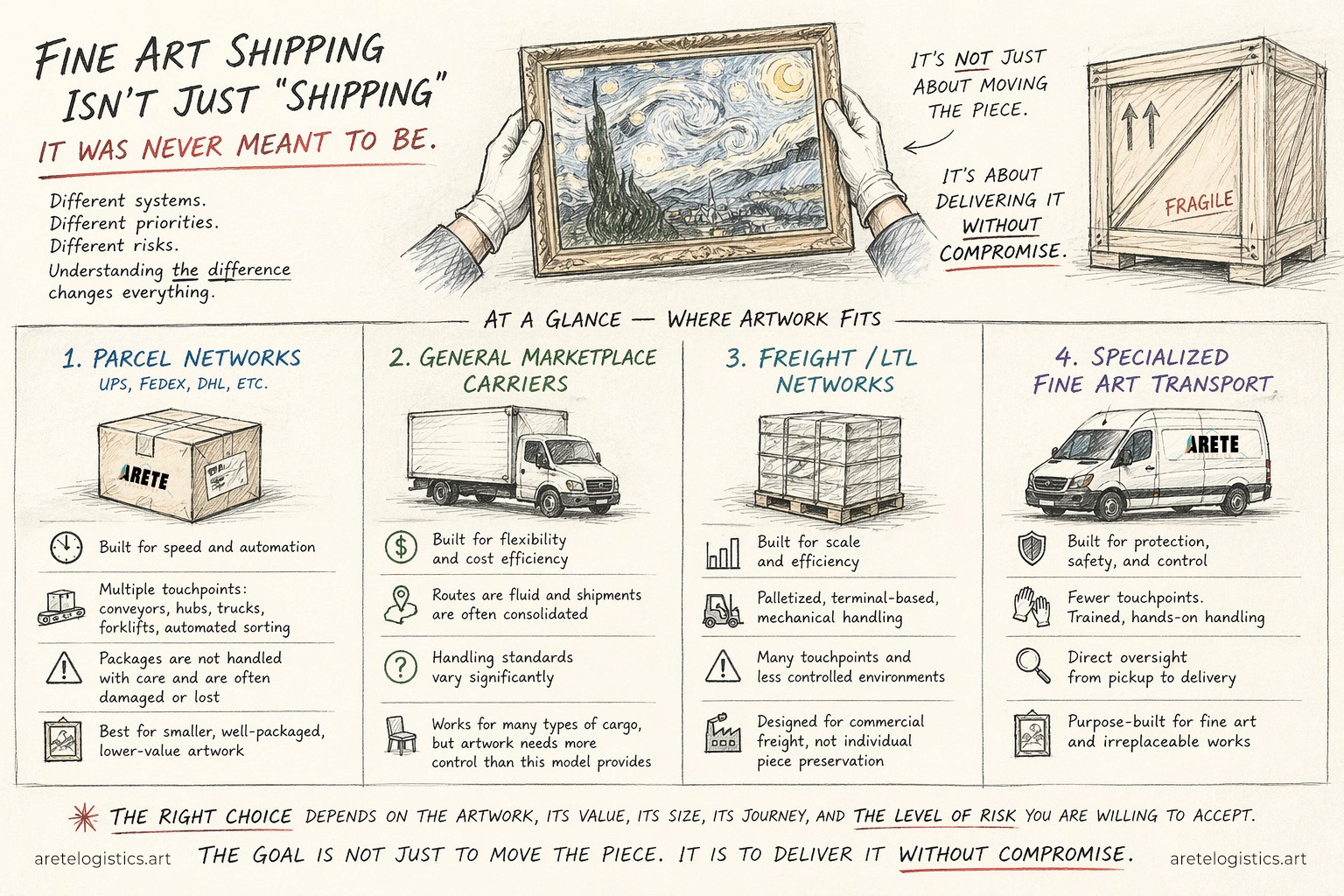
Why Is Fine Art Shipping So Expensive? (And Why It’s Not What You Think)
Fine art shipping costs more than standard freight due to specialized handling, insurance structure, compliance, and risk management. Learn why artwork requires a different level of transport care.
Read More -->
"Aiding and Abetting" in Fine Art Shipping? Stop Hiring Illegal Carriers to Ship Artwork
Shippers can face serious legal, financial, and operational consequences for hiring a carrier that lacks proper federal licensing or operating authority when transporting artwork and high-value goods across state lines.
Read More -->

Why Vetting Your Fine Art Shipper Matters
Hiring an unlicensed fine art shipping company in Colorado can put your artwork, reputation, and wallet at serious risk. Here’s what galleries, artists, and collectors need to know.
Read More -->

Understanding Fine Art Shipping Insurance: What You Need to Know
Not sure if your artwork is actually insured during transit? Learn what all-risk fine art insurance covers, what declared value protection plans don't, and what to ask your art shipper before you ship.
Read More -->
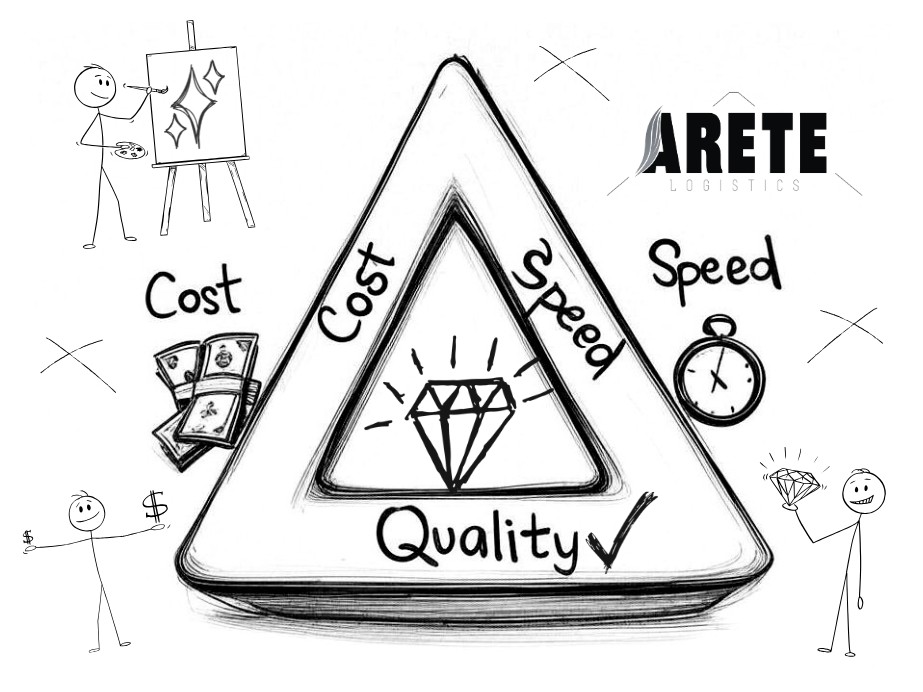
The “Iron Triangle” in Fine Art Shipping: Cost, Speed, & Quality
In fine art shipping, you can't optimize for cost, speed, and quality at the same time. Here's what the Iron Triangle means and how to make smarter trade-offs.
Read More -->
Fine Art Shipping Insurance: What Most Shippers Aren't Telling You
Your artwork probably isn't as protected as you think. Here's what declared value coverage actually is, what it isn't, and what true fine art insurance looks like.
You paid for insurance through a major parcel carrier. The piece was damaged in transit. The claim was denied.
If that sentence makes your stomach drop, good. It should. Because it happens every single day, to artists, galleries, and collectors who thought they were protected and weren't. Not because they did anything wrong. Because what they bought wasn't insurance.
Here's what's actually going on.
What Most Shippers Call "Insurance" Often Isn't
When you pay extra to "declare a value" on a shipment, whether through a major parcel carrier, a regional art shuttle, or a fine art handler, you probably assume you're buying insurance. In most cases, you aren't.
Many shippers and carriers offer programs with names like "Shipment Protection Options," "Optional Loss Protection Program," "declared value coverage," or "full value protection." They often present these in ways that sound like insurance. They aren't.
FedEx states this explicitly in their own service guide, in all caps: "WE DO NOT PROVIDE INSURANCE COVERAGE OF ANY KIND." UPS says the same thing. So do many art-specific handlers, if you read their terms carefully enough. One major national fine art logistics company goes so far as to note in its own documentation, in parentheses, that the additional fee clients pay for declared value is "NOT INSURANCE." They capitalized it themselves.
What they're selling is called declared value coverage, and it is a fundamentally different product from insurance. Understanding the difference could save you a devastating financial loss.

So What Is Declared Value Coverage?
Declared value coverage is a legal mechanism, not an insurance policy. It comes from federal law, specifically the Carmack Amendment (49 U.S.C. § 14706), which governs how motor carriers handle liability for goods in transit.
Here's how it works in practice:
By default, a carrier's liability for lost or damaged goods is capped at $0.60 per pound. On a 15-pound painting worth $20,000, that's $9. When you declare a value and pay an additional fee, you're raising that liability cap. You are not buying a policy. You are not protected by an insurer. You are simply paying the carrier to agree that if something goes wrong and they are proven to be at fault, they might pay you more.
The key phrase is proven to be at fault. The carrier investigates itself. The carrier decides whether it was responsible. And the carrier controls whether a check gets written.
Here's how that plays out in practice. An artist or seller files a claim after their piece arrives damaged. They spend weeks in back and forth. They are eventually told the claim is denied because they could not prove negligence on the part of the carrier. In other words: it wasn't their fault, so they don't have to pay. There is no independent arbiter. There is no appeals process backed by insurance law. There is just the carrier's internal decision, and that's final.
The Fine Art Cap Nobody Tells You About
Here's where it gets significantly worse for artists and galleries specifically.
Individual packages containing artwork, paintings, drawings, vases, limited-edition prints, fine art, statuary, sculpture, and collectors' items are limited to a maximum declared value of $1,000 at FedEx. Regardless of the actual value of the piece. Regardless of how much you paid to declare a higher value.
You can declare $10,000, pay the fee for $10,000, and if your painting is destroyed, the maximum liability is $1,000. The fee you paid for the additional declared value? Non-refundable.
UPS mirrors the FedEx logic almost line for line. And there's an additional trap specific to UPS: on declared value above $1,000, UPS Ground and Air require the shipment to be handed directly to the driver and logged on a High Value Shipment Report. Miss that step and the declared value coverage is void entirely, even if you paid for it.
These limits apply even if you're using FedEx Ground instead of Express, which some shippers assume offers a workaround. It doesn't. The category cap on artwork applies across services.
This is not a gray area. It is documented in carrier service guides that most people never read, because nothing in the checkout or booking process makes it obvious. And if you're wondering why dedicated fine art couriers exist and why they charge what they do, this is a significant part of the answer.
The Packaging Trap
Even when a claim seems straightforward, there's another obstacle waiting: the packaging exclusion.
Inadequate packaging is the leading cause of claim denials. Carriers enforce strict packaging guidelines covering box strength, cushioning, void fill, and drop-test standards. Even with clear carrier mishandling, shipments not meeting these requirements face denial.
For fine art, this exclusion is particularly punishing. Artwork often cannot be packed the way carriers require. A large canvas, a sculpture, an antique frame, a work on paper: none of these conform neatly to the double-box, drop-test standards carriers use to evaluate claims. When damage occurs, the carrier's first response is almost always to question the packaging. That questioning frequently ends the claim before it begins.
Artist communities have documented this pattern for years. One longtime seller summarized it plainly: I've known of several artist friends who tried to claim insurance on artwork damaged in shipment, and after many hours and sometimes close to two years, they're still looking at having to hire a lawyer to force the claim through, or taking the shipper to small claims court.
That's the lived experience behind the fine print.
It's Not Just the Major Carriers
You might assume that art-specific shippers, the ones who specialize in fine art transport and understand what they're handling, operate differently. Some do. Many don't.
Across the industry, a pattern emerges regardless of company size. Programs are internally managed. There is no licensed underwriter. There is no certificate of insurance. And the fine print is loaded with conditions that make a successful claim the exception rather than the rule.
Common exclusions seen across these programs include:
Damage attributed to inadequate or non-pristine packaging
Normal wear and tear during transport
Age deterioration
Undisclosed fragility, temperature sensitivity, or orientation requirements
Any damage where the handler's fault cannot be clearly established
The fee for these programs is typically around 1% of the artwork's declared value, and most companies present it as a standard line item in their quotes. When you see "Optional Loss Protection: $250" on an estimate for a $20,000 piece, it sounds like protection. What it actually represents is a conditional, internally managed reimbursement agreement with significant carve-outs, no independent oversight, and no guarantee of payout.
For more on what vetting a fine art shipper actually involves, and the right questions to ask before you book, this is worth reading first. And if you're working with a shipper who isn't properly licensed or registered as a motor carrier, your exposure is even greater than these programs suggest, something we cover in detail here.
Declared Value vs. True Fine Art Insurance: The Real Difference
Declared Value Coverage | True All-Risk Fine Art Insurance | |
|---|---|---|
Backed by a licensed insurer | No | Yes |
Certificate of insurance (COI) | No | Yes |
Regulated by state insurance law | No | Yes |
Pays regardless of who is at fault | No | Yes |
Independent claims process | No | Yes |
Covers fine art at full value | No | Yes |
Hard caps on artwork value | Yes | No |
Packaging exclusions | Yes | Limited |
True all-risk fine art insurance, the kind offered by underwriters like Chubb, AXA XL, Hiscox, and Great American Fine Art, covers the full agreed value of the artwork from the moment it leaves one wall to the moment it reaches the next. It pays out regardless of who caused the damage. It is regulated, enforceable, and backed by a licensed insurer who is contractually obligated to honor claims under the terms of the policy.
That is a completely different product from what most carriers and art handlers are offering. For a full breakdown of the types of fine art insurance available and how they compare, our guide to fine art shipping insurance covers this in detail.
Who Is Actually Responsible for Insuring Artwork in Transit?
This is the question the art world largely avoids answering directly, and the ambiguity costs people money every year.
The short answer: it depends on the agreement. And if there is no clear agreement, everyone assumes someone else handled it.
Here's how it typically breaks down across common scenarios:
Artist ships work to gallery for consignment
In a well-drafted consignment agreement, the gallery is responsible for insuring the artwork nail-to-nail: from pickup, through the exhibition, through return shipping, and back to the artist's studio if the work doesn't sell. In practice, many consignment agreements are vague on this point. Some explicitly state that the gallery is not responsible for theft, loss, or destruction of any kind, and that the artist is solely responsible for all shipping costs including insurance. That language directly contradicts what most artists assume when they hand over their work. Read your consignment agreement carefully before a piece leaves your studio, and if it's silent on insurance, ask for clarification in writing before anything ships.
Gallery ships sold artwork to collector
This typically falls under the gallery's responsibility and should be covered under a fine art dealer's policy. If the gallery is relying on a parcel carrier's declared value program, the collector may be significantly exposed without knowing it. Galleries should be transparent with buyers about how sold works are protected during transit.
Artist ships directly to a collector
The artist is responsible. Unless they carry their own fine art transit policy, they are almost certainly unprotected beyond whatever carrier liability applies. For most artists shipping independently through major carriers, that means a $1,000 hard cap on artwork regardless of what was declared or paid for.
Gallery returns unsold work to artist
Governed by the consignment agreement. If the agreement is silent on return shipping insurance, the question of who bears the risk of loss during the return journey is genuinely unresolved. Get it in writing before the work moves.
Artwork on loan to a museum or institution
Museums and institutions typically require nail-to-nail coverage defined in the loan agreement itself. The agreement should establish insurable interest, define the exact coverage period, set the agreed valuation, and specify who arranges and pays for that coverage. If those details aren't in the agreement before the work ships, they're assumptions, and assumptions in fine art transit are expensive.
The throughline across all of these scenarios is the same: too many people operate under dangerous assumptions. "The shipper's coverage will protect me." "My homeowners policy automatically covers art in transit." "The gallery handles insurance." None of these assumptions are safe without documentation to back them up. For more on how insurance types compare and what Arête Logistics carries, our fine art insurance guide covers this in full.
Why We Don't Offer a Protection Program
You'll notice that Arête Logistics doesn't offer a declared value protection program. That's intentional.
We're not licensed insurance brokers, and we don't believe in charging clients for coverage that comes with the kind of conditions and exclusions this blog describes. Our cargo and commercial auto coverage is documented, transparent, and available to review in our Terms of Service. What it covers and what it doesn't is spelled out plainly, because we think you deserve to know exactly what you're working with before your artwork gets in our van.
If we can't offer you something that genuinely protects your artwork, we'd rather be honest about that and point you toward the real thing.
The Red Flags to Watch For
Whether you're an artist evaluating an art handler, a gallery reviewing your coverage, or a collector buying a significant work, these are the signs that what you're being offered is declared value coverage dressed up as something more:
🚩 The word "insurance" appears in conversation or on a quote but no COI is provided
🚩 No underwriter is named anywhere in the documentation
🚩 The program is described as a "protection plan," "loss protection," or "shipment protection option"
🚩 Coverage is conditional on who packed the piece, the condition of the packaging, or prior disclosure of fragility or special handling needs
🚩 Claims are handled internally by the shipper, not by a third-party insurer
🚩 The cost is approximately 1% of declared value with no formal policy document to review
🚩 The shipper cannot answer the question: "Who is the underwriter on this coverage?"
If an art handler cannot provide a certificate of insurance with a named underwriter, what they are offering is a contractual liability arrangement. Not insurance.
What to Do Instead
Securing your own fine art transit insurance is the only way to ensure your artwork is genuinely protected in transit. Options include:
A dedicated wall-to-wall fine art policy from providers like Chubb, AXA XL, Hiscox, or Great American Fine Art. These policies cover the full agreed value of the work from pickup to delivery, regardless of fault, and pay out on agreed value rather than depreciated or actual cash value.
A marine transit rider added to an existing homeowners or gallery policy. Confirm with your broker that the rider covers third-party art handlers and your specific transit routes before relying on it.
Nail-to-nail coverage specified in your consignment or loan agreement, with the responsible party's COI provided and verified before any work moves.
Your insurance broker is the right starting point. If you don't have one who understands fine art specifically, it's worth finding one who does. Getting the coverage right before the artwork leaves the wall is always easier than sorting out a claim afterward. For a full breakdown of fine art insurance types and how to think about protecting your work, our companion guide covers everything you need to know.
The Bottom Line
The art world runs on trust: between artists and galleries, galleries and collectors, and art handlers and their clients. Declared value coverage exists within that trust gap, dressed in language that sounds protective and functions as something far more limited.
Most carriers say it plainly in their own documentation, if you know where to look. Many art handlers say it in theirs too, buried in terms most clients never read. The artwork is not insured. The handler's liability is capped. Packaging exclusions give them a ready-made reason to deny. And if something goes wrong, the burden of proving fault falls on you.
Before your next shipment, ask one question: is this actual insurance, or is it declared value coverage? Get the answer in writing. And if the answer is declared value, make sure you have your own policy before the artwork leaves the wall.
Fine Art Shipping Insurance: What Most Shippers Aren't Telling You
Your artwork probably isn't as protected as you think. Here's what declared value coverage actually is, what it isn't, and what true fine art insurance looks like.
You paid for insurance through a major parcel carrier. The piece was damaged in transit. The claim was denied.
If that sentence makes your stomach drop, good. It should. Because it happens every single day, to artists, galleries, and collectors who thought they were protected and weren't. Not because they did anything wrong. Because what they bought wasn't insurance.
Here's what's actually going on.
What Most Shippers Call "Insurance" Often Isn't
When you pay extra to "declare a value" on a shipment, whether through a major parcel carrier, a regional art shuttle, or a fine art handler, you probably assume you're buying insurance. In most cases, you aren't.
Many shippers and carriers offer programs with names like "Shipment Protection Options," "Optional Loss Protection Program," "declared value coverage," or "full value protection." They often present these in ways that sound like insurance. They aren't.
FedEx states this explicitly in their own service guide, in all caps: "WE DO NOT PROVIDE INSURANCE COVERAGE OF ANY KIND." UPS says the same thing. So do many art-specific handlers, if you read their terms carefully enough. One major national fine art logistics company goes so far as to note in its own documentation, in parentheses, that the additional fee clients pay for declared value is "NOT INSURANCE." They capitalized it themselves.
What they're selling is called declared value coverage, and it is a fundamentally different product from insurance. Understanding the difference could save you a devastating financial loss.
So What Is Declared Value Coverage?
Declared value coverage is a legal mechanism, not an insurance policy. It comes from federal law, specifically the Carmack Amendment (49 U.S.C. § 14706), which governs how motor carriers handle liability for goods in transit.
Here's how it works in practice:
By default, a carrier's liability for lost or damaged goods is capped at $0.60 per pound. On a 15-pound painting worth $20,000, that's $9. When you declare a value and pay an additional fee, you're raising that liability cap. You are not buying a policy. You are not protected by an insurer. You are simply paying the carrier to agree that if something goes wrong and they are proven to be at fault, they might pay you more.
The key phrase is proven to be at fault. The carrier investigates itself. The carrier decides whether it was responsible. And the carrier controls whether a check gets written.
Here's how that plays out in practice. An artist or seller files a claim after their piece arrives damaged. They spend weeks in back and forth. They are eventually told the claim is denied because they could not prove negligence on the part of the carrier. In other words: it wasn't their fault, so they don't have to pay. There is no independent arbiter. There is no appeals process backed by insurance law. There is just the carrier's internal decision, and that's final.
The Fine Art Cap Nobody Tells You About
Here's where it gets significantly worse for artists and galleries specifically.
Individual packages containing artwork, paintings, drawings, vases, limited-edition prints, fine art, statuary, sculpture, and collectors' items are limited to a maximum declared value of $1,000 at FedEx. Regardless of the actual value of the piece. Regardless of how much you paid to declare a higher value.
You can declare $10,000, pay the fee for $10,000, and if your painting is destroyed, the maximum liability is $1,000. The fee you paid for the additional declared value? Non-refundable.
UPS mirrors the FedEx logic almost line for line. And there's an additional trap specific to UPS: on declared value above $1,000, UPS Ground and Air require the shipment to be handed directly to the driver and logged on a High Value Shipment Report. Miss that step and the declared value coverage is void entirely, even if you paid for it.
These limits apply even if you're using FedEx Ground instead of Express, which some shippers assume offers a workaround. It doesn't. The category cap on artwork applies across services.
This is not a gray area. It is documented in carrier service guides that most people never read, because nothing in the checkout or booking process makes it obvious. And if you're wondering why dedicated fine art couriers exist and why they charge what they do, this is a significant part of the answer.
The Packaging Trap
Even when a claim seems straightforward, there's another obstacle waiting: the packaging exclusion.
Inadequate packaging is the leading cause of claim denials. Carriers enforce strict packaging guidelines covering box strength, cushioning, void fill, and drop-test standards. Even with clear carrier mishandling, shipments not meeting these requirements face denial.
For fine art, this exclusion is particularly punishing. Artwork often cannot be packed the way carriers require. A large canvas, a sculpture, an antique frame, a work on paper: none of these conform neatly to the double-box, drop-test standards carriers use to evaluate claims. When damage occurs, the carrier's first response is almost always to question the packaging. That questioning frequently ends the claim before it begins.
Artist communities have documented this pattern for years. One longtime seller summarized it plainly: I've known of several artist friends who tried to claim insurance on artwork damaged in shipment, and after many hours and sometimes close to two years, they're still looking at having to hire a lawyer to force the claim through, or taking the shipper to small claims court.
That's the lived experience behind the fine print.
It's Not Just the Major Carriers
You might assume that art-specific shippers, the ones who specialize in fine art transport and understand what they're handling, operate differently. Some do. Many don't.
Across the industry, a pattern emerges regardless of company size. Programs are internally managed. There is no licensed underwriter. There is no certificate of insurance. And the fine print is loaded with conditions that make a successful claim the exception rather than the rule.
Common exclusions seen across these programs include:
Damage attributed to inadequate or non-pristine packaging
Normal wear and tear during transport
Age deterioration
Undisclosed fragility, temperature sensitivity, or orientation requirements
Any damage where the handler's fault cannot be clearly established
The fee for these programs is typically around 1% of the artwork's declared value, and most companies present it as a standard line item in their quotes. When you see "Optional Loss Protection: $250" on an estimate for a $20,000 piece, it sounds like protection. What it actually represents is a conditional, internally managed reimbursement agreement with significant carve-outs, no independent oversight, and no guarantee of payout.
For more on what vetting a fine art shipper actually involves, and the right questions to ask before you book, this is worth reading first. And if you're working with a shipper who isn't properly licensed or registered as a motor carrier, your exposure is even greater than these programs suggest, something we cover in detail here.
Declared Value vs. True Fine Art Insurance: The Real Difference
Declared Value Coverage | True All-Risk Fine Art Insurance | |
|---|---|---|
Backed by a licensed insurer | No | Yes |
Certificate of insurance (COI) | No | Yes |
Regulated by state insurance law | No | Yes |
Pays regardless of who is at fault | No | Yes |
Independent claims process | No | Yes |
Covers fine art at full value | No | Yes |
Hard caps on artwork value | Yes | No |
Packaging exclusions | Yes | Limited |
True all-risk fine art insurance, the kind offered by underwriters like Chubb, AXA XL, Hiscox, and Great American Fine Art, covers the full agreed value of the artwork from the moment it leaves one wall to the moment it reaches the next. It pays out regardless of who caused the damage. It is regulated, enforceable, and backed by a licensed insurer who is contractually obligated to honor claims under the terms of the policy.
That is a completely different product from what most carriers and art handlers are offering. For a full breakdown of the types of fine art insurance available and how they compare, our guide to fine art shipping insurance covers this in detail.
Who Is Actually Responsible for Insuring Artwork in Transit?
This is the question the art world largely avoids answering directly, and the ambiguity costs people money every year.
The short answer: it depends on the agreement. And if there is no clear agreement, everyone assumes someone else handled it.
Here's how it typically breaks down across common scenarios:
Artist ships work to gallery for consignment
In a well-drafted consignment agreement, the gallery is responsible for insuring the artwork nail-to-nail: from pickup, through the exhibition, through return shipping, and back to the artist's studio if the work doesn't sell. In practice, many consignment agreements are vague on this point. Some explicitly state that the gallery is not responsible for theft, loss, or destruction of any kind, and that the artist is solely responsible for all shipping costs including insurance. That language directly contradicts what most artists assume when they hand over their work. Read your consignment agreement carefully before a piece leaves your studio, and if it's silent on insurance, ask for clarification in writing before anything ships.
Gallery ships sold artwork to collector
This typically falls under the gallery's responsibility and should be covered under a fine art dealer's policy. If the gallery is relying on a parcel carrier's declared value program, the collector may be significantly exposed without knowing it. Galleries should be transparent with buyers about how sold works are protected during transit.
Artist ships directly to a collector
The artist is responsible. Unless they carry their own fine art transit policy, they are almost certainly unprotected beyond whatever carrier liability applies. For most artists shipping independently through major carriers, that means a $1,000 hard cap on artwork regardless of what was declared or paid for.
Gallery returns unsold work to artist
Governed by the consignment agreement. If the agreement is silent on return shipping insurance, the question of who bears the risk of loss during the return journey is genuinely unresolved. Get it in writing before the work moves.
Artwork on loan to a museum or institution
Museums and institutions typically require nail-to-nail coverage defined in the loan agreement itself. The agreement should establish insurable interest, define the exact coverage period, set the agreed valuation, and specify who arranges and pays for that coverage. If those details aren't in the agreement before the work ships, they're assumptions, and assumptions in fine art transit are expensive.
The throughline across all of these scenarios is the same: too many people operate under dangerous assumptions. "The shipper's coverage will protect me." "My homeowners policy automatically covers art in transit." "The gallery handles insurance." None of these assumptions are safe without documentation to back them up. For more on how insurance types compare and what Arête Logistics carries, our fine art insurance guide covers this in full.
Why We Don't Offer a Protection Program
You'll notice that Arête Logistics doesn't offer a declared value protection program. That's intentional.
We're not licensed insurance brokers, and we don't believe in charging clients for coverage that comes with the kind of conditions and exclusions this blog describes. Our cargo and commercial auto coverage is documented, transparent, and available to review in our Terms of Service. What it covers and what it doesn't is spelled out plainly, because we think you deserve to know exactly what you're working with before your artwork gets in our van.
If we can't offer you something that genuinely protects your artwork, we'd rather be honest about that and point you toward the real thing.
The Red Flags to Watch For
Whether you're an artist evaluating an art handler, a gallery reviewing your coverage, or a collector buying a significant work, these are the signs that what you're being offered is declared value coverage dressed up as something more:
🚩 The word "insurance" appears in conversation or on a quote but no COI is provided
🚩 No underwriter is named anywhere in the documentation
🚩 The program is described as a "protection plan," "loss protection," or "shipment protection option"
🚩 Coverage is conditional on who packed the piece, the condition of the packaging, or prior disclosure of fragility or special handling needs
🚩 Claims are handled internally by the shipper, not by a third-party insurer
🚩 The cost is approximately 1% of declared value with no formal policy document to review
🚩 The shipper cannot answer the question: "Who is the underwriter on this coverage?"
If an art handler cannot provide a certificate of insurance with a named underwriter, what they are offering is a contractual liability arrangement. Not insurance.
What to Do Instead
Securing your own fine art transit insurance is the only way to ensure your artwork is genuinely protected in transit. Options include:
A dedicated wall-to-wall fine art policy from providers like Chubb, AXA XL, Hiscox, or Great American Fine Art. These policies cover the full agreed value of the work from pickup to delivery, regardless of fault, and pay out on agreed value rather than depreciated or actual cash value.
A marine transit rider added to an existing homeowners or gallery policy. Confirm with your broker that the rider covers third-party art handlers and your specific transit routes before relying on it.
Nail-to-nail coverage specified in your consignment or loan agreement, with the responsible party's COI provided and verified before any work moves.
Your insurance broker is the right starting point. If you don't have one who understands fine art specifically, it's worth finding one who does. Getting the coverage right before the artwork leaves the wall is always easier than sorting out a claim afterward. For a full breakdown of fine art insurance types and how to think about protecting your work, our companion guide covers everything you need to know.
The Bottom Line
The art world runs on trust: between artists and galleries, galleries and collectors, and art handlers and their clients. Declared value coverage exists within that trust gap, dressed in language that sounds protective and functions as something far more limited.
Most carriers say it plainly in their own documentation, if you know where to look. Many art handlers say it in theirs too, buried in terms most clients never read. The artwork is not insured. The handler's liability is capped. Packaging exclusions give them a ready-made reason to deny. And if something goes wrong, the burden of proving fault falls on you.
Before your next shipment, ask one question: is this actual insurance, or is it declared value coverage? Get the answer in writing. And if the answer is declared value, make sure you have your own policy before the artwork leaves the wall.